Bart Farrell: First things first, who are you, what's your role, and where do you work?
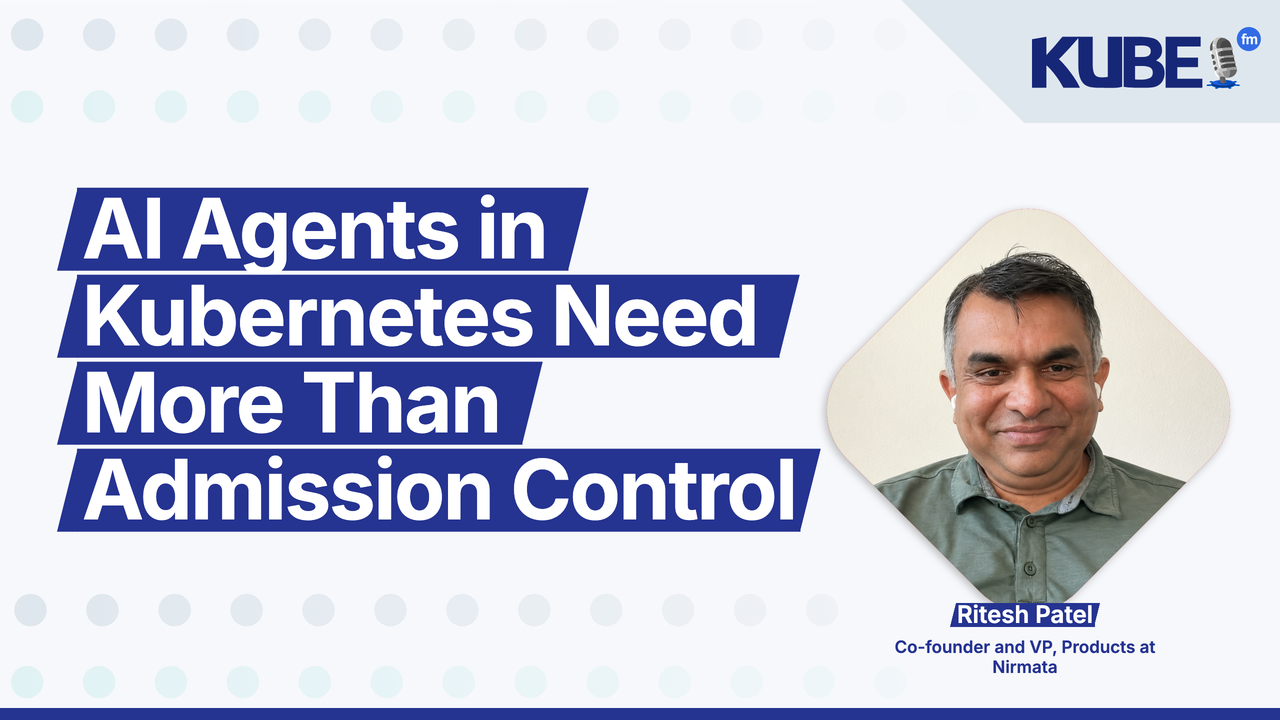
Ritesh Patel: I'm Ritesh Patel. I'm VP of Products and co-founder at Nirmata. It is a company behind Kyverno and an open-source CNCF-graduated policy engine. We've been in infrastructure and AI governance space for several years now.
Bart Farrell: You're using AI agents to move from simply detecting Kubernetes policy violations to actually generating remediation and even opening GitOps for requests. Where should that automation stop and what guardrails need to be in place before an AI-generated fix is trusted in production?
Ritesh Patel: That's a great observation. I think over the last year, we've moved from just using AI for generating automation to AI enabling and doing the automation itself. So we started, with things like remediation. But all of this involves a human in the loop. Ultimately, we want to make sure that every change that is made is safe. AI can be leveraged to remediate issues, accelerate that cycle between platform teams and operators, and create pull requests that developers and others can accept and introduce to their production systems. But what we are seeing is we can go beyond that. If you look at Kubernetes operations there is a lot of workflows that can leverage AI and that can be automated through AI. So we built up a workflow engine called AutoFlow. It's an open-source engine which can be leveraged to do things like troubleshooting and things like security analysis and triaging and so on. That's where we see things moving. Obviously, all of this has to happen with the right AI guardrails in place. And that is very important given that governance and infrastructure governance has been focused for several years.
Bart Farrell: Nirmata, as you mentioned, is extending the same policy-driven thinking behind Kyverno into AI governance. As agents start calling models, tools, and APIs from inside Kubernetes, what new control points do platform teams need that traditional admission control simply doesn't cover?
Ritesh Patel: We are seeing that firsthand. Traditional admission controls originally started out as part of Kubernetes and the Kubernetes API server. They were extended to CI/CD pipelines given that a lot of changes were introduced to GitOps, and you want to make sure we catch any issues early. But with AI, the agents typically are nondeterministic due to AI reasoning, they could perform actions or decide what actions to perform on the fly, you need a couple of other enforcement points or control points. First one being runtime. Making sure that agent is only able to communicate with websites or specific APIs that they need to use to get the job done. And that can be done through some kind of runtime controls as through eBPF or more and more you're seeing sandboxes come up where agents are being deployed in sandboxes that provide those types of capabilities and those capabilities are again policy-driven; it depends on the type of agent and then there is also a gateway. Every request that an agent makes to a model or to an MCP could include some kind of vulnerability, whether it's a prompt injection or whether it's some kind of attack sequence that needs to be detected. And the way that can happen is through a gateway. So those are the two new control points that we see are needed in addition to the existing ones that we've come to be used to in Kubernetes.
Bart Farrell: And Ritesh, one of the promises of AI-augmented operations is reducing toil across large Kubernetes fleets. In practice, where do you think AI can make the biggest difference today? Diagnostics, remediation, policy generation, incident response, and where is the technology still not mature enough to trust?
Ritesh Patel: AI can make a lot of difference in all of the different areas you talked about, and we see, especially with large fleets of clusters, diagnostics and remediation is a huge productivity boost. A lot of time is spent diagnosing issues, before even coming up with remediation. With AI automation, the diagnosis and triaging can happen quickly. An AI agent can go collect all the relevant information from various sources, and even interpret that for the platform engineer, so that is a big area. The other area where we see AI making a difference is the whole policy enforcement piece. Policies are needed. But what we saw is, there's a lot of reluctance or even friction in actually writing the policies, no matter how easy you make it. But now with AI, what you can do is have automated policy generation based on gaps that are detected in your infrastructure. And then with human in the loop, once a human approves it, those can be applied. From that perspective, this provides a lot of benefit to increase the coverage that you had from a security and governance perspective. So, I see those two as the big areas. Now, to your other question about is the technology mature to trust? I think in certain areas, yes, but when it comes to actually making change to production, we still need to follow the best practices. We cannot trust AI to make the right change at the right time without oversight. So again, the best practice we've seen is to have AI make suggestions, have AI create pull requests, or have AI create automation, but then have humans review, provide some oversight before those changes make it into production. So I think that's worked pretty well so far. And with that, we see a lot of gains in terms of productivity as well as resilience and stability and security of infrastructure.
Bart Farrell: Well, Ritesh, thanks so much for sharing your time and knowledge with us today. Look forward to the next steps and speaking to you in future. Take care.
Ritesh Patel: Great. Thanks, Bart.