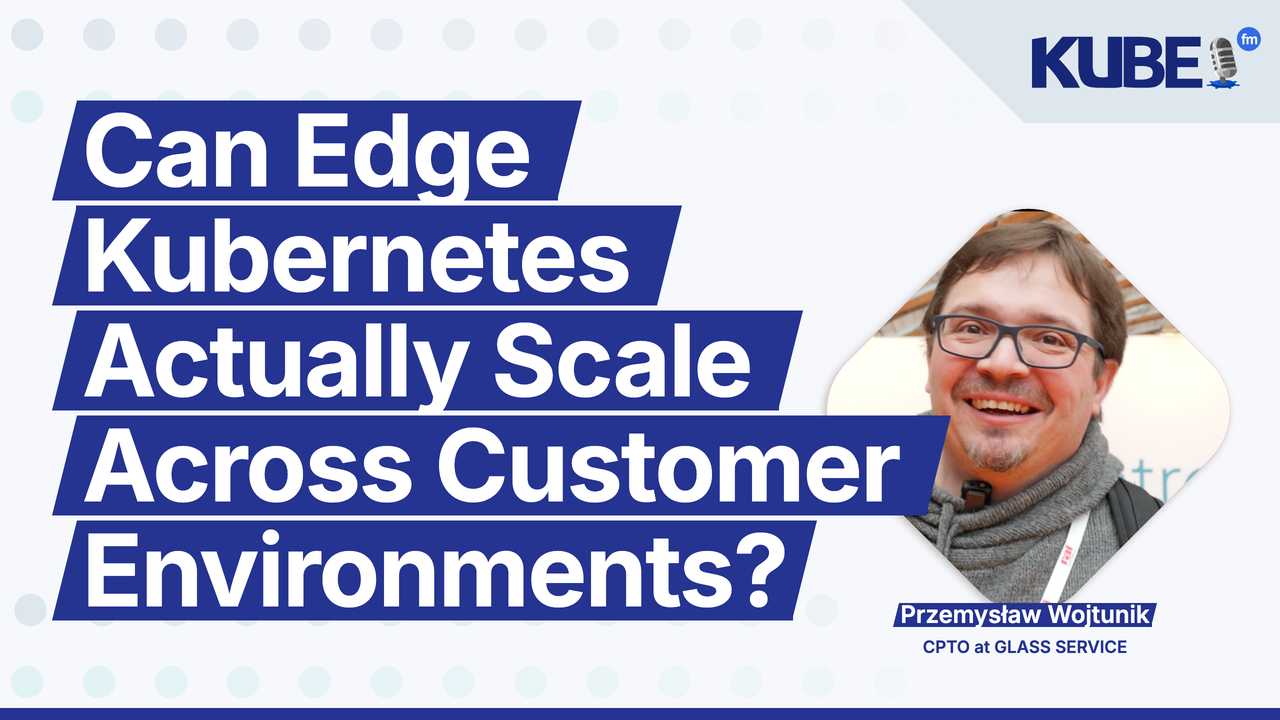
Bart Farrell: So first things first, who are you, what's your role and where do you work?
Przemysław Wojtunik: So my name is Przemyslaw Wojtunik. I work as the Chief Product and Technology Officer for Saint-Gobain. The business unit is GLASS SERVICE. We are providing the technology for the glass manufacturer, mostly digital technology but also the hardware technology.
Bart Farrell: What are three emerging Kubernetes tools that you are keeping an eye on?
Przemysław Wojtunik: So technically we are doing huge evolutions of the legacy software that we have. And the key point is that we start deploying the edge environment in the customers, our solution based on Kubernetes. So one of the technologies is really k3s, that is our edge solutions. Then we heavily use the Dapr technology to build the microservice application. And of course, we need to have the fleet management and in that case, the Spectro Cloud, our partner, is helping us in this transition.
Bart Farrell: We're here at KubeCon Europe. And sovereign cloud is a big theme. Governments and regulated industries both want full control over where workloads run. What changes about your Kubernetes operating model when you can't lean on the hyperscaler?
Przemysław Wojtunik: So the sovereignty, step by step I see more answers from the customers that are asking these topics and lots of our customers don't want to go to the cloud because they are really asking who is behind the technology. So we will be really focusing on on-premise installation.
Bart Farrell: And so when we're thinking about security and compliance, these are things that people are naturally resistant towards, aren't very excited about. We're thinking about the rollout of CRA that's coming up relatively soon. How do we create a culture of consciousness around these issues, making people feel empowered rather than feeling threatened?
Przemysław Wojtunik: I think one of the things is also the partner of the Spectro Cloud, because they will give us this extra boost to comply with CRA regarding the security and the SBOM. But still, we need to, I think each organization needs to find a good path to be implementing this by the daily life here.
Bart Farrell: A lot of teams manage clusters differently depending on whether they're on EKS, GKE, Bare Metal or something else entirely. Is multi-distro Kubernetes actually manageable at scale or do most teams just pick one and stick with it?
Przemysław Wojtunik: I think most teams pick one. In our case, we are based on the on-premise solution, but also we base our solution on AKS. In Azure, it's depending where the customers want to go with the data and onboarding to our solution.
Bart Farrell: Supply chain security keeps coming up. Signed images, SBOMs, verifiable builds. Where are you seeing teams actually adopt this in practice versus just talking about it at conferences?
Przemysław Wojtunik: To be honest, because we belong to the huge organization and one of our normal routines is really this workflow starting from building to deploying on JFrog to validating by Xray, signing, verifying, and then we can go to the customer. So for me, it's something natural and I cannot develop the software in the other way. I think it should be mandatory for any kind of development.
Bart Farrell: Now that you have experience running Kubernetes at the edge, for teams out there that might be considering doing this, what things would you recommend that they should keep in mind if they want to get started? What's the first step they should be taking?
Przemysław Wojtunik: so first step, doing this in small steps, build the target, and then find a good solution that will help you manage everything at scale, because that is important. You can quickly develop and deploy the solution, but finally, how you will manage this, how you will be providing, what will be your size of the team. If you're not finding the good solutions at the end, then I am clear that you will have pain when you will be scaling your application.
Bart Farrell: Kubernetes turned 10 years old about two years ago. Looking towards the future, what can we expect in the next few years, particularly when it comes to running Kubernetes at the edge?
Przemysław Wojtunik: that is a good question. To be honest, I was not thinking how the future should look like. But yes, from my point of view, it is now. Lots of evolution, involve the people, and be open.
Bart Farrell: What's next for you?
Przemysław Wojtunik: So next for me will be upskilling the team, involving more people and organizations like Saint-Gobain to be more related to the Kubernetes solutions because currently I am something like the frontrunner that is providing the solutions and then I need to internally build a new culture that we will be deploying new type of applications.
Bart Farrell: How can people get in touch with you if they want to learn more about your experience?
Przemysław Wojtunik: So you can find me on LinkedIn, Przemyslaw Wojtunik. My name is very complex, I know, but if you find me then I can accept you.