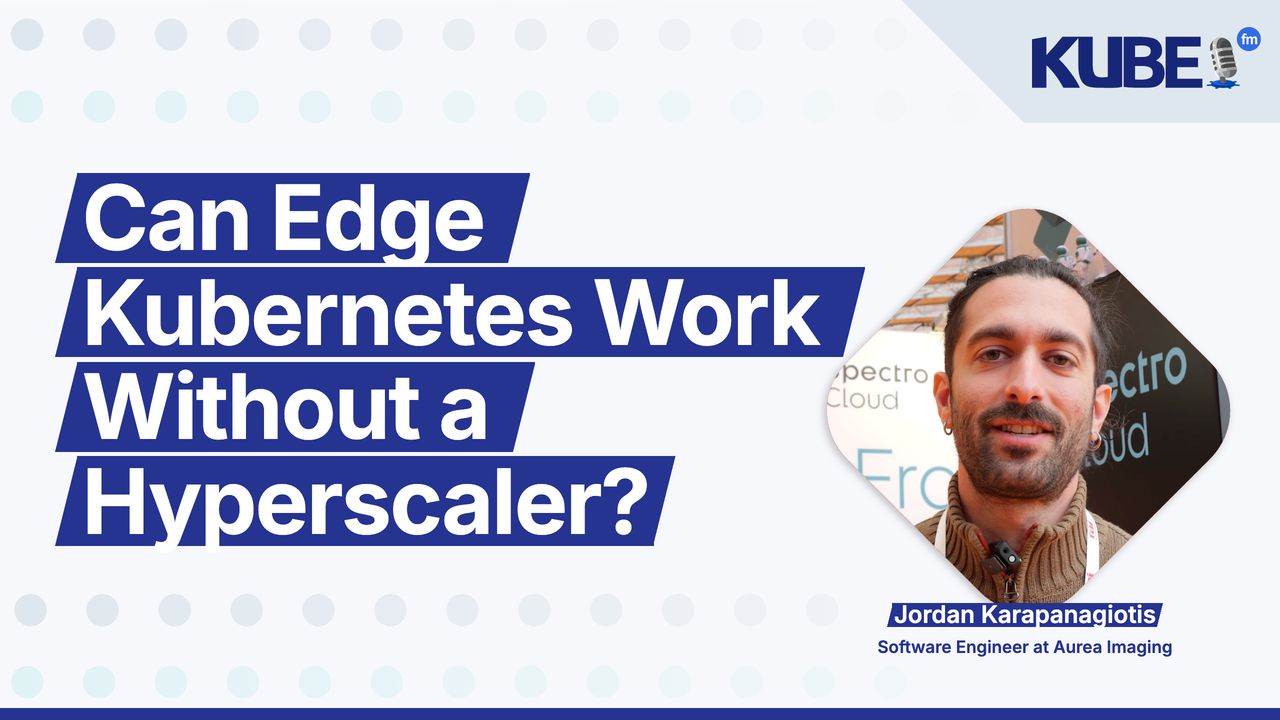
Bart Farrell: So first things first, who are you, what's your role and where do you work?
Jordan Karapanagiotis: So I'm Jordan, I work for Aurea Imaging as a software engineer. I focus mainly on the IoT data side and the edge computing side. And I'm here at the Spectro Cloud booth, which we have been cooperating a lot with our Kairos projects the last one and a half years.
Bart Farrell: Now what are three emerging Kubernetes tools that you are keeping an eye on?
Jordan Karapanagiotis: Obviously k3s because we are using it and it's rapidly evolving. We keep an eye on K0s as well because it's a lightweight distribution of Kubernetes that we could potentially use. And of course, the usual open source technologies like Argo CD, Flux for more GitOps operations, for more GitOps automatic updates.
Bart Farrell: So we're hearing a lot about AI, but you're actually running AI on NVIDIA at the edge, literally in the field, because we're talking about physical fields. Give us some context about the kind of stuff that you're working with, why you decided to end up using the technologies you're using.
Jordan Karapanagiotis: We are running AI on tractors in the fields in precision agricultural applications. The reason we do that is because we have a lot of data to be processed in a short amount of time. We are very limited with bandwidth, so we have to do all the heavy lifting on the edge before sending more lightweight data to the cloud. So we have to do all the AI inference on the edge. We have to detect blossoms, fruits, we also do vigor detection. So we have to run all of our machine learning models on the edge, do the AI inference there, and then send the process data to the cloud for further processing and visualization.
Bart Farrell: Now, sovereign cloud is a big theme at KubeCon EU this year. Governments and regulated industries want full control over where workloads run. What changes about your Kubernetes operating model when you can't lean on the hyperscaler?
Jordan Karapanagiotis: We're not really leaning on the hyperscaler anyway on the edge device because we do run Kubernetes on our NVIDIA Jetson boards on the cloud side. It's something that we have to take into account as we do have to be the new hyperscaler provider we have to take care of all the networking stuff for example to configure them with the RBAC in Kubernetes but mostly on the edge side is something that we anyway do
Bart Farrell: Do a lot of teams manage clusters differently depending on whether they're on EKS, GKE, bare metal or something else entirely? Is multi-distro Kubernetes actually manageable at scale? Or do most teams just pick one and stick with it?
Jordan Karapanagiotis: That's an interesting one because we do run K3s on the edge on bare metal. And we also use GKE on our cloud Kubernetes. So it's mostly a matter of knowledge of the team. And it's what you inherited, what was there already. And then it's becoming a bit of a habit. It's kind of tricky. You have to build a platform around it. If you break something on a node level, then you really need to know how to fix that on the distribution that you're working for, like if it's on Google or if it's on bare metal. So you really need to have the knowledge of what is on the base layer of the platform and the networking and possibly security as well.
Bart Farrell: So for teams that are considering running Kubernetes on the edge, what are some top tips that you would recommend or things they should absolutely keep in mind if they're going to get started.
Jordan Karapanagiotis: Really keep the image lightweight. As we do over the air updates, we are limited with bandwidth, usually on edge devices, so you really need to take that into account. And also, you really need to take into account where the cluster is deployed, what's your node like, what is your host, and the networking layer of that. How does the cluster integrate with the networking layer of the host? Because that's where we see most of our challenges in remote environments like agriculture, in air-gapped environments. IPs are not necessarily static, you connect through 4G, IPs change, you might have some DNS priority issues, so you really need to know networking to manage that.
Bart Farrell: Okay, so networking is absolutely essential. Looking towards the future of Kubernetes, about two years ago, Kubernetes turned 10 years old. Looking at the next few years on Kubernetes, when it comes to networking, AI, or running Kubernetes at the edge, what can we expect? What do you think will happen?
Jordan Karapanagiotis: I think we're going to see a big shift towards Kubernetes on the edge. I see in this conference now there are quite a few talks and people interested in that, but I think it's going to become bigger. We're going to see it in factories, possibly in the industry, maybe in defense, in satellites. I've seen already quite some interesting talks. And I think it's going to get more traction as we move away from the traditional cloud providers and we're running a lot of applications on the edge. And Kubernetes is an integral part of that.
Bart Farrell: And what's next for you, Jordan?
Jordan Karapanagiotis: For us as a company, we are working now on upgrading our NVIDIA stack. And that's going to happen with Kairos, the immutable OS that we are using. And it's quite a challenge to keep up to date with industry standards in the NVIDIA ecosystems. But with that, we can always do it over the air remotely as we have devices deployed in the field globally.
Bart Farrell: And if people want to get in touch with you to learn more about your experience running Kubernetes at the edge, what's the best way to do that?
Jordan Karapanagiotis: You can reach me through jordan@aureaimaging.com or through my LinkedIn profile.