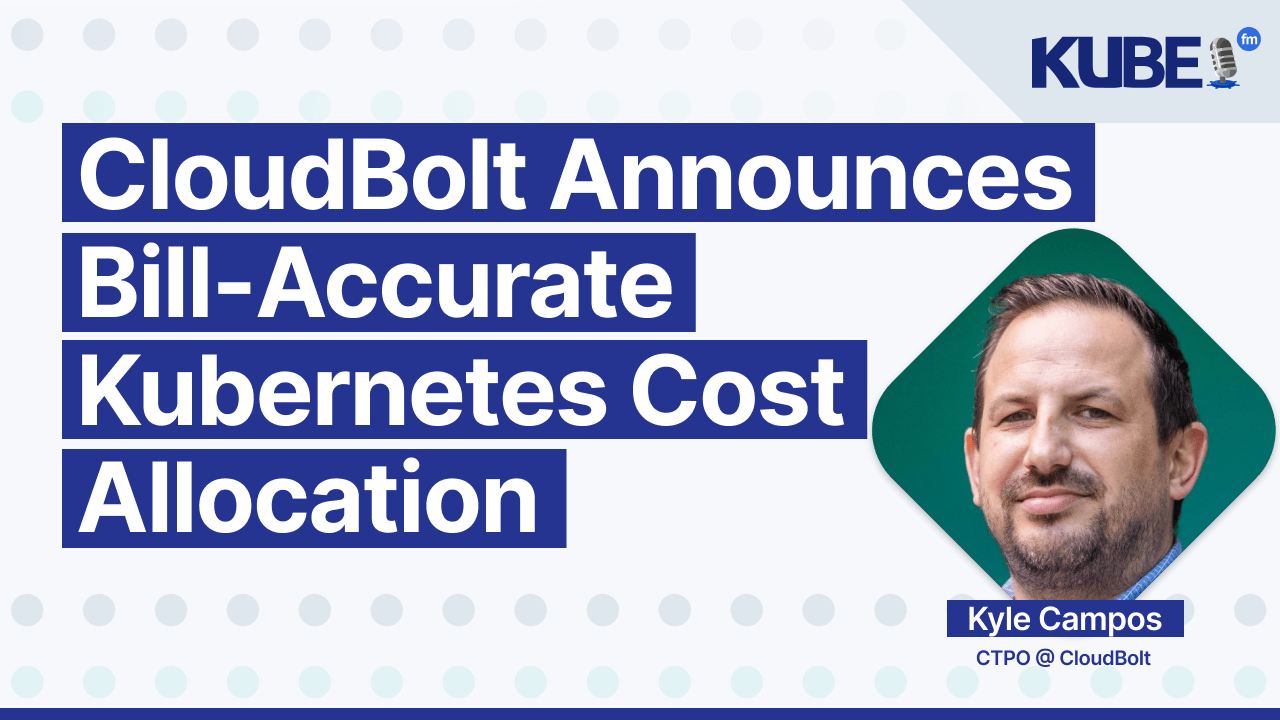
Bart: First, who are you, what's your role, and where do you work?
Kyle: I am Kyle Campos, Chief Technology and Product Officer at CloudBolt.
Bart: What news are you bringing to our audience today?
Kyle: Today, we're announcing the launch of our Kubernetes cost allocation. This brings together our capabilities in Kubernetes right-sizing and FinOps, enabling cost allocation down to the container level.
Bart: I need more context from the transcript to accurately identify and link terms related to Kubernetes cost allocation. Could you provide the full transcript or more details about the specific discussion?
Without the full context, I cannot confidently apply hyperlinks or provide a comprehensive answer about the challenges of Kubernetes cost allocation. The guidelines require me to use existing links, and without a specific resource table, I would not want to create arbitrary links.
If you can share more of the transcript or provide a links table, I'll be happy to help identify key terms and create appropriate hyperlinks.
Kyle: More than half of Kubernetes users can't allocate costs down to the workload level. We're bringing awareness and visibility to areas where there's still significant blindness. This helps bring together previously siloed teams: platform engineering teams managing Kubernetes and doing optimization work, and FinOps teams trying to report cost drivers inside clusters—which they historically haven't had much access to.
Bart: How does this announcement change the landscape compared to what existed before?
Kyle: Our secret sauce is bringing optimization and reporting together into one platform. As mentioned before, teams have been blind to this or have had to use separate solutions and try to unify that data layer. We are bringing those capabilities together into one solution. We've heard from our users asking us to do this, which is perhaps an obvious next step as CloudBolt came together with StormForge. We're excited to bring those two experiences together.
Bart: And for our open source community, is Kubernetes cost allocation open source? And where does it fit in the CNCF landscape?
Kyle: The product itself is not open source, but we have built this cost allocation on top of the FOCUS specification, which is part of the Linux Foundation. It is an open source specification for cost and usage coming out of cloud providers. We use it to not only ingest the real billing data but also to export it. After we've done this cost allocation, we are always FOCUS compliant on export as well. So we're not locking up your data.
Bart: Can you break down StormForge's business model and pricing structure for teams that are evaluating this solution?
Kyle: StormForge is typically priced against resource level, cluster size, vCPU count. On the FinOps side, we typically charge as total cloud spend under management. You can get started for free on StormForge by going to our website. There's a sandbox there and a free trial you can get started on.
Bart: When people are exploring this space, which alternative solutions might they be considering alongside yours?
Kyle: KubeCost is the one we hear most often from our customers. These same customers have been asking us to build into this space and do better. That's what we've tried to do on the FinOps side. Many of our customers don't have anything and are blind to this space. We're trying to bring together those teams into a common product experience.
Bart: What key advantages set Kubernetes cost allocation apart from similar solutions in the market?
Key terms I've linked:
Kyle: I think our secret sauce is having the right sizing recommendations alongside cost allocation. It's important on the platform engineering side to know the cost implications of not applying a recommendation or not turning on auto mode for a cluster, so they can see the real cost impact.
For FinOps users, accurate showback and chargeback is crucial in bringing defensibility to help their business move forward. However, they don't want to just report facts. They want to see where there is room to improve and implement cost savings. Having both aspects together is a powerful combination.
Bart: Looking ahead, what developments can our audience anticipate from Kubernetes cost allocation and StormForge?
Kyle: We're really excited to explore the space of having granular utilization data and cost data coming together from the same agent. You can imagine interesting opportunities around budgets, perhaps at a namespace label perspective, with early warning systems. How does the forecast model get adjusted based on recommendation engines and seasonality? Typically, at the Kubernetes level, it's been pretty black box for FinOps teams. Now that we're opening that up, there are many exciting opportunities.
Bart: And how can interested listeners connect with you to learn more or get started?
Kyle: Visit our website, CloudBolt.io. You can find us here at KubeCon, reach us on LinkedIn, and connect with us on all our social media channels.
Bart: So, for our listeners who might be interested in knowing more, what information should they check out?
Kyle: You can go to our website at cloudbolt.io/k8s-preview (K8s Preview, all one word). It'll get you information about this new release and access to it.