Bart Farrell: First things first, who are you, what's your role, and where do you work?
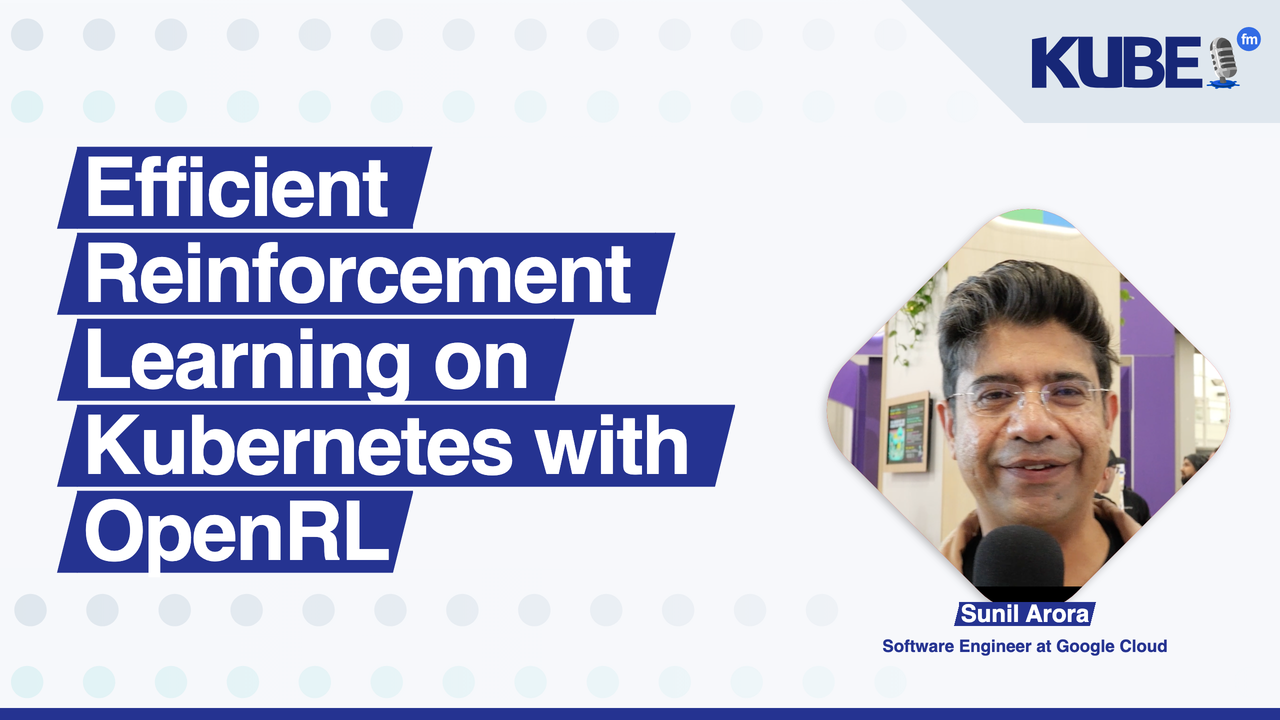
Sunil Arora: Hi, I'm Sunil. I'm a software engineer on the Google GKE team, and I lead the OpenRL project.
Bart Farrell: Excellent. Now, the AI industry keeps talking about GPU shortages, yet reinforcement learning pipelines can leave expensive accelerators idle while waiting for environments, rewards, and other stages to finish. How much of our GPU problem is insufficient hardware, and how much is inefficient infrastructure?
Sunil Arora: I think a bit of both. If you look at the pre-training kind of workload, then insufficient GPUs is a real problem, in a supply-constrained environment like this. But when it comes to post-training and reinforcement learning, the real problem is more about the GPUs that you have, how well actually are you using them. because if you look at the nature of reinforcement learning jobs, the RL loop alternates between different types of work. it would be generating answers which you call sampling it would be executing let's say tool calls in a sandbox or would be computing a reward that would also may happen either in a sandbox or let's say calling a judge model so as it alternates between different types of work and if only GPU is allocated to the entire RL job it GPUs may be sitting idle so you know it may not be using all the GPU fully so that's a problem so there it's not the insufficient GPUs it's like GPUs not being utilized properly. So
Bart Farrell: OpenRL aims to make reinforcement learning workloads more efficient and portable. What does it change about how training resources are allocated and shared? And which assumptions about existing training infrastructure does it challenge?
Sunil Arora: the one fundamental assumption that it challenges is that each RL job needs its own GPU. So OpenRL allows you to share your GPUs among multiple RL jobs. And as each RL job has these inefficiencies because of the kind of work that it does so OpenRL is able to kind of when one RL job has its GPUs are sitting idle it's actually able to place another RL job on that GPU and how it does this: it breaks each RL job into a sequence of training and sampling steps and now it's able to place those steps on a fleet of accelerators And one way to think about this would be. If you look at Kubernetes, with Kubernetes what we did, we had the basic compute unit pod and we were able to pack those pods on multiple nodes. And the similar way, OpenRL is able to pack these training steps and sampling steps on a fleet of accelerators.
Bart Farrell: Okay. The biggest AI companies can afford enormous proprietary training infrastructure. What can engineers at smaller organizations actually deploy or experiment with using OpenRL today? And what should they measure to know whether it's delivering meaningful improvements?
Sunil Arora: one is OpenRL implements a Tinker-compatible endpoint. So what that means is all the existing recipes like Tinker cookbooks, you can use all the off-the-shelf recipes out of the box with OpenRL. So that's great. So you have recipes available. Second thing is you don't need just to experiment with, you can just start with a Kubernetes cluster with a single GPU node and, you know, get started with it. We have made it really easy. Like a single Kubernetes manifest, you can deploy on a Kubernetes cluster to kind of get OpenRL up and running. And when it comes to the measurement part, I would say try to run multiple experiments on a set of hardware that you have with OpenRL and then measure what is kind of the GPU duty cycle you are seeing. Like that would actually give you an idea how well your GPUs are being utilized. And you should also pay attention to like what is the overall clock time you know for your jobs if there is let's say a longer queue lens let's say the jobs are waiting a lot more then probably you need to add more accelerators those are the few things i would say to measure and one more thing you should also see how many experiments in parallel you are able to run would be another because that's the key strength of open rl i think those would be few things i would keep an eye on
Bart Farrell: Good. Sunil, what's next for you?
Sunil Arora: So what's next for me? So OpenRL, we donated it to CNCF, so it's a CNCF project. So we are very excited about the roadmap we have. We are adding support for TPUs to OpenRL. We are adding more recipes. We open-sourced a recipe called Harvey Lab Recipe, which lets you train on legal agents. And we are also kind of working with the communities like LLMD. to kind of make better integration of Open RL. So I'm really excited about the opportunity to work with the CNCF community and take this roadmap forward.
Bart Farrell: Excellent. And if people want to get in touch with you, what's the best way to do that?
Sunil Arora: So I think for OpenRL, I would say I regularly look at the GitHub issues. So please file an issue. I will also be more active on the Slack, CNCF Slack that we have. So that would be another one. And I'm also on Twitter. So please DM me on that.