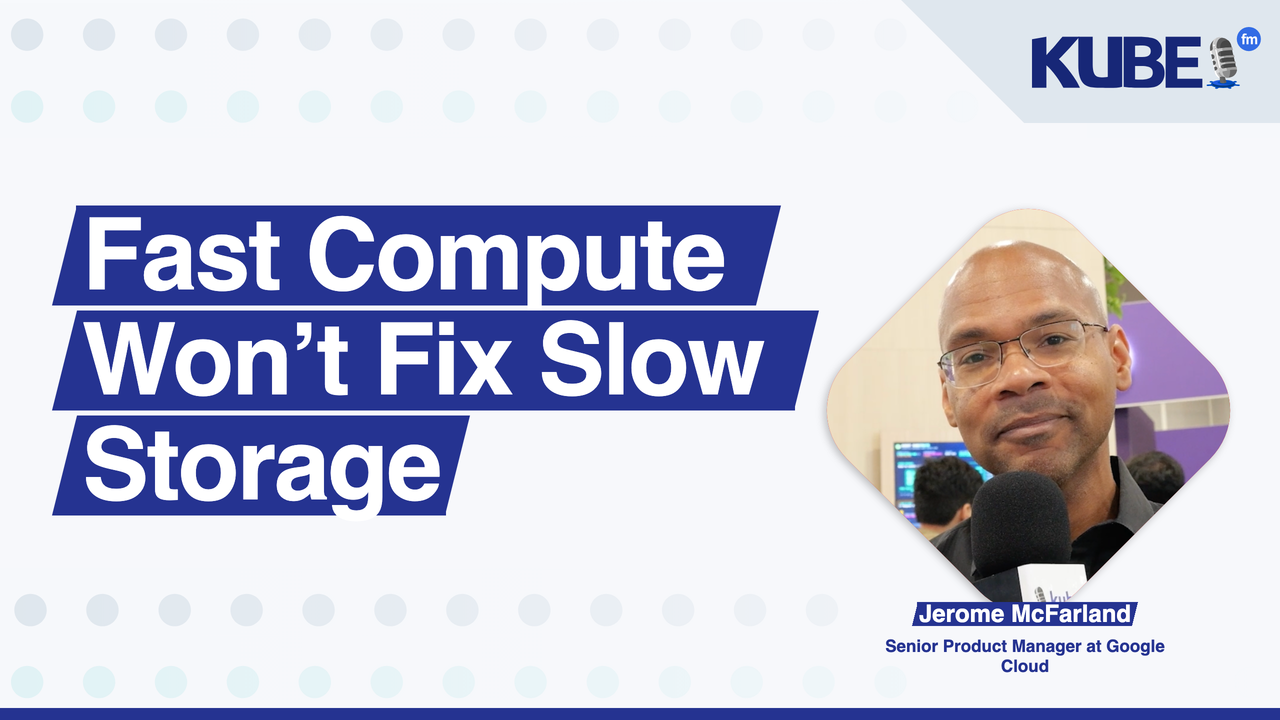
Bart Farrell: Who are you, what's your role, and where do you work?
Jerome McFarland: I'm Jerome McFarland. My role is a senior product manager for Google Cloud.
Bart Farrell: Everyone's focused on making AI agents smarter and cheaper to run, but those agents still need access to files and persistent state. Are platform teams underestimating storage as one of the biggest barriers to operating agent fleets at scale?
Jerome McFarland: I don't know if I would say that they're underestimating the storage, but what we've seen as we talk to customers is that often storage can be somewhat of an afterthought. There's a pretty justified focus on optimizing the compute for agentic infrastructure and other aspects of the agentic stack. But sometimes storage can get left to the end. And when that happens, unfortunately, sometimes then you can discover at the last minute that the storage is not actually able to keep up with all the other optimizations that you've implemented.
Bart Farrell: We already have mature cloud storage technologies. What's fundamentally different about storage for agents that constantly start, stop, resume, and potentially share files? How do Filestore agent volumes address those challenges?
Jerome McFarland: When you think about the agentic workloads that have been emerging, and in particular, the fast start-stop-resume that you mentioned, they have a very unique set of requirements that place some correspondingly unique requirements on the storage. So in particular, the very fast start-stop and resume, that leads to a situation where to optimize your infrastructure utilization, you want to be very efficient in how you apply the resources. So idle agents shouldn't be consuming expensive resources because they're not actually doing any work. So on the compute side, the optimizations that frameworks like Agent Substrate have implemented allow you to switch the compute to agents exactly when they need to do work and then switch it away instantaneously when they don't need to do work. So in that way, you're maximizing your ability to leverage the compute that you have at hand. Now, if you do all those optimizations on the compute side, but then you don't actually have the appropriate optimization on the storage side, you kind of thwart your ability to gain the end-to-end benefits. Specifically, you think about an agent that is going idle after doing some work. At that point, optimized compute is going to switch away, go to some agent that's ready to do work. And then when the original agent is ready to come back, it'll get some new compute so it can continue. But if the storage isn't actually able to reattach to that agent and the new compute instantaneously, now this compute is going to sit waiting for the storage, underutilized, and you've kind of really eliminated the benefit that you've been seeking. So the storage really needs to support that fast attach. We also see requirements around shareability. There are use cases where agents need to collaborate. We need to be able to consistently and efficiently write to and read from the same workspace. And so you need storage designed such that it can handle that in a consistent fashion to avoid agents stepping on one another. So those are just some examples, but really the main story headline here is that the storage needed to be designed for the agentic use cases.
Bart Farrell: For engineers experimenting with persistent agent workspaces today, what should they actually deploy or benchmark? And what's the architectural mistake they're most likely to make?
Jerome McFarland: I think when you're thinking about storage deployments for agentic infrastructure, the main guidance that I would give around what to deploy and benchmark is really to plan for the scale that you expect in production. There's one set of things that you might do at smaller scale, which could give you some signals that what you've implemented is going to work functionally. But when you think about these agentic workloads, the scale that they operate on and the scale that they grow to is massive. And so what worked at small scale may not work properly at large scale. In particular, when we're talking about these sorts of infrastructure optimization strategies, it's really at scale that those really come into play and they kind of show their full benefit. So when you're deploying and testing agentic infrastructure, in particular the storage, I would say do things like benchmark the attach latency as an example. The ability for storage to quickly attach to compute is fundamental and it's important, but those benefits really show up from the infrastructure optimization perspective at scale. So make sure that even at small scales, you're testing for that. Shareability is another one. As you scale and you have potentially massive swarms of agents with some subsets of those agents needing to collaborate, make sure that you can implement infrastructures that allow those agents to collaborate and write and read shared files effectively, even at scale. So the TL;DR here is really design and plan for the future state where you could be running thousands, in some cases, millions of agents on a given infrastructure and make sure that you're planning your tests and your evaluations to support that.