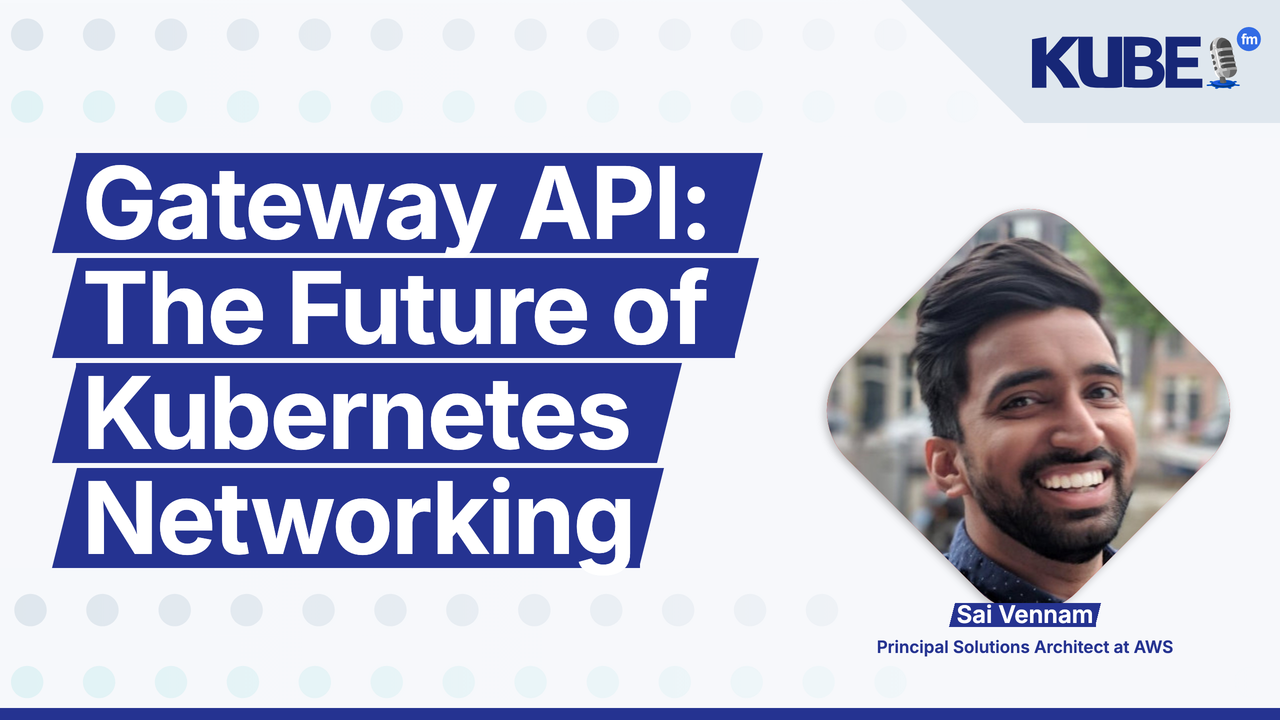
Bart Farrell: First things first, who are you? What's your role and where do you work?
Sai Vennam: My name is Sai Vennam, and I'm a Principal Solutions Architect at AWS. And what gets me excited about work is being able to enable the next generation of developers and SREs.
Bart Farrell: What are three emerging Kubernetes tools that you're keeping an eye on?
Sai Vennam: I'm going to pick an answer that covers all three in one. We call it the EKS Capabilities Framework. Essentially, it's ACK, Amazon Controllers for Kubernetes, KRO to the Kubernetes Resource Orchestrator, as well as Argo CD, but managed Argo CD. And together, we call it the EKS Capabilities Framework, because it allows SREs, developers, architects, to go to the next stage from just infrastructure as code, to infrastructure as API, a reconciler loop that's always keeping your infrastructure in check, and using a Kubernetes control plane as that source of truth. That's my one answer for the three emerging technologies.
Bart Farrell: What problems do engineers run into when exposing services with Ingress and Kubernetes, which is going away?
Sai Vennam: so Ingress, love it. It's been around for a long time. But we've been talking about that evolution of Ingress into Gateway API. Not API Gateway, but Gateway API, which is this essentially, as I called it, an evolution. Ingress is great, but there's a number of challenges with it. So for one, annotations got really messy. Anytime you wanted to modify how the load balancer worked, like maybe you wanted stickiness and configuring the stickiness of sessions, well, you'd have to stick something into the annotation. And that actually leads me to the second problem with Ingress is that it covered both the what, like the route of what you're trying to expose as well as how it's being exposed. And it did so in the same file, like an Ingress or a service of type load balancer. And generally, teams are separated. The platform teams and the admins are not the same ones who are defining what needs to be exposed. So a lot of mixing the roles.
Bart Farrell: And so why should customers migrate over to Gateway API?
Sai Vennam: So I think the obvious reason customers should migrate over to Gateway API is because the community has decided Gateway API is the natural evolution of Ingress. And Ingress will be going away. Don't worry, it's not deleted. It's not gone right now. I'd say one of the biggest reasons to migrate the Gateway API though, is the role-based design. Now, platform admins can define things like gateways, which define how the load balancers are created. Cloud services providers can provide gateway classes that hook into the underlying services. And then app devs now get to define routes, HTTP routes, TCP routes, whatever they need, that allow them to actually define what they want to expose, like their application routes.
Bart Farrell: What should teams prioritize when planning their migration to Gateway API?
Sai Vennam: Any sort of migration in the Kubernetes world is going to take time, and you want to do so carefully without impacting your production applications. So to migrate to Gateway API, especially now that AWS has added support for the Gateway API and the AWS Load Balancer Controller, if you're trying to migrate, something to consider is annotations are no longer marked directly on the load balancer resources. Instead, they're YAML native. So we have new CRDs, TCP configuration CRDs, target group configuration CRDs, that allow you to set those previously annotation configured settings, but now YAML native, get an inventory of all the annotations you have, you'll know how you're going to move them over to the new configurations. That's going to be the biggest step for you for migrating to Gateway API, especially in Amazon EKS with the application load balancer controller.
Bart Farrell: So how does Amazon EKS simplify the Gateway API adoption journey?
Sai Vennam: Amazon simplifies the migration and the journey to Gateway API through a couple of ways. So of course, I already mentioned our load balancer controller now supports Gateway API, just enable a feature flag and you can start leveraging the new native Gateway API style way of setting up your load balancers. But also, we've actually had support for Gateway API through the Lattice Gateway API controller. VPC Lattice, the service within AWS that gives you service mesh-like qualities, together with the application, with the load balancer controller supporting Gateway API, as well as the VPC Lattice Gateway API controller, you can now natively through Gateway API, north-south, applications accessing your applications, users accessing your applications, as well as east-west traffic between your services, using a mix of Gateway API implementation the load balancer controller, as well as the VPC Lattice gateway API controller.
Bart Farrell: Kubernetes turned 10 years old almost two years ago. What should we expect in the next 10 years to come?
Sai Vennam: So having been part of the Kubernetes world for the better part of the last 10 years, I think the biggest shift we're seeing is that operators are spending less and less time operating and managing the heavy lift of Kubernetes clusters. And developers are able to spend more time on business logic. So we see that trend shifting, especially with AI agents and LLMs making it further more streamlined on how to manage operators. So we're going to see this almost absentee operator model. And I think companies are going to shift more of a focus to business logic. What's next for you? So one of the things that's always gotten me excited is helping enable developers, SREs and architects coming to conferences like these. Lately, a big focus for me has been workshops. We know customers love attending workshops at events and conferences, but they want to do these at home. So one of the things we've been ramping up lately is the ability for customers to sign up for AWS specialist-led workshops from the comfort of where they work, from home, wherever. We give you an account, you go through a workshop at your own pace, and we think customers are really liking this experience to learn Kubernetes.
Bart Farrell: If people want to get in touch with you, what's the best way to do that?
Sai Vennam: Best way to reach me is on LinkedIn, but check out our videos on YouTube on Containers from the Couch. See you there.