Bart Farrell: So who are you, what's your role, and where do you work?
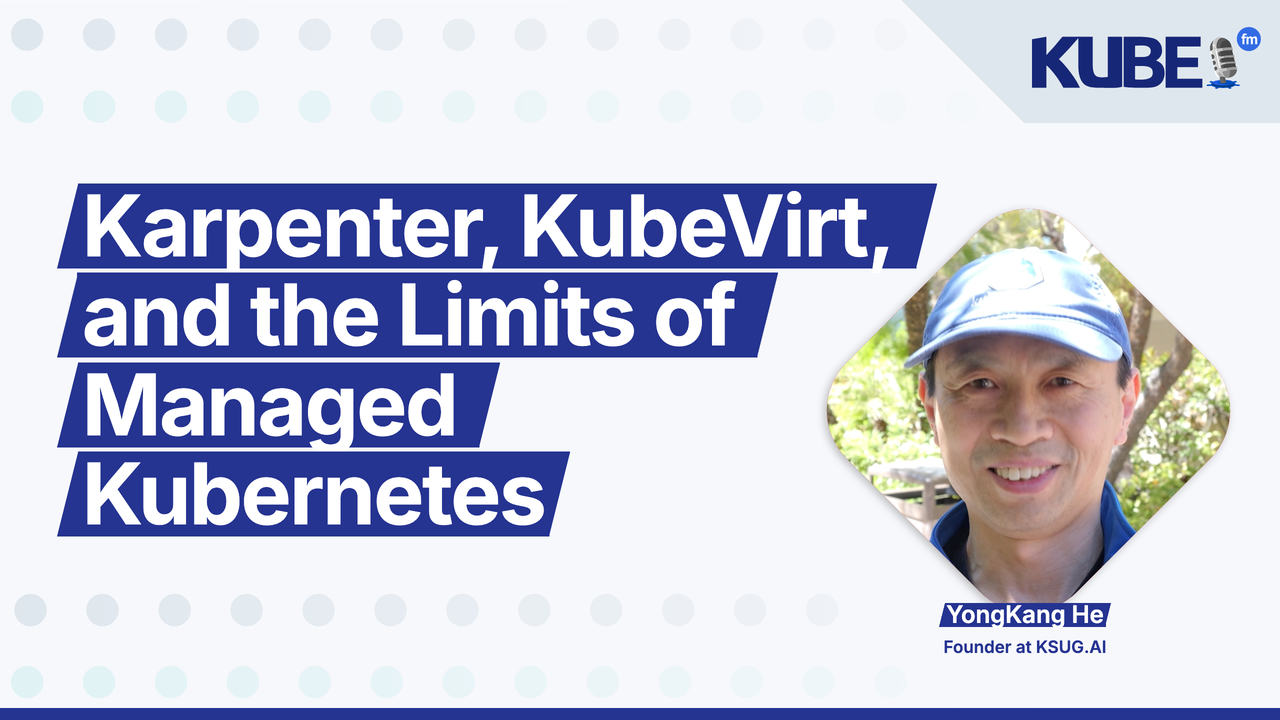
YongKang He: My name is YongKang He. I'm the founder of KSUG.AI, one of the most active Kubernetes and AI communities globally with over 200,000 members and followers. I spend most of my time helping people to learn faster, certify smarter, and grow stronger in cloud, Kubernetes, and now AI.
Bart Farrell: Now, what are three emerging Kubernetes tools that you're keeping an eye on?
YongKang He: I would say the first one is Karpenter because the cost keeps growing. With Karpenter, it's redefining the auto scaling beyond the traditional node groups, especially for cost and performance efficiency. The second one is KubeVirt. Bringing VMs into Kubernetes is becoming very real, especially for enterprise, modernizing the legacy applications. The number three I would say is WASM. This is a big one. Running lightweight secure workloads, especially for AI inference, feels like a major shift in how we think about computing Kubernetes.
Bart Farrell: Managed Kubernetes services keep promising to remove operational burden. At what point does abstraction stop being helpful because your team can no longer explain or debug what happened in production?
YongKang He: Abstraction is great until your team loses the ability to explain the failure. If your engineer cannot answer why did this pod restart or why did the latency spike, then you've gone too far. So managed Kubernetes should remove undifferentiated heavy lifting, not remove understanding. The best team I see treat abstraction as a production layer, not a knowledge replacement. You still need enough visibility into logs, metrics, events, and more importantly, people who know how to interpret them.
Bart Farrell: And what about cost visibility and managed Kubernetes?
YongKang He: The cost is where managed Kubernetes often surprises people. It looks simple at the start, but things like minimum resource ratio, idle workload, and observability cost add up very quickly. What works for me is to treat cost as a first-class metric, not an afterthought, and use tools like OpenCost or cloud-native billing insights, and more importantly, educate developers.
Bart Farrell: There is great interest in using AI systems to operate Kubernetes rather than just generate YAML. Which cluster operations would you hand over first, and which ones are too risky to automate?
YongKang He: Oh, that's a very interesting question. I will start with low-risk, high-volume tasks. Things like anomaly detection, correlation, log summarization. Maybe even basic remediation suggestions. What I don't really trust right now is production scaling decisions. That might increase the cost significantly. Like security policies can be security risks and also cost upgrade. That can be also very challenging. The key is guardrails. AI should assist the operators, not replace them, at least for now. We're moving toward AI as a co-pilot for SRE not fully autonomous clusters.
Bart Farrell: Kubernetes turned 10 years old about two years ago. What should we expect in the next 10 years?
YongKang He: Oh, that's interesting. Kubernetes, I would say, becomes a universal control plane, not just for containers. We've already seen VMs like KubeVirt, AI workloads running on GPU, TPU for the inference pipelines running serverless. In the next 10 years, I think Kubernetes will become the platform that runs everything. But the real shift is from managing Kubernetes' infrastructure to managing intent. And AI will play a big role in that transition.
Bart Farrell: What's next for you, Yongkang?
YongKang He: I'm doubling down on KSUG.AI, especially around AI, Kubernetes, and FinOps. We are launching more hands-on workshops, building real-world demos, and also expanding globally. We are expanding and exploring things like FinOps Academy, AI learning tracks, and helping more people break into the cloud without paying a crazy amount of money. That's always been our mission.
Bart Farrell: And how can people get in touch with you?
YongKang He: The best place is LinkedIn. I just crossed 53,000 LinkedIn followers. Just search YongKang He, you should be able to find me. Or you can join our community, just visit ksug.ai. We've got Discord, WhatsApp, Telegram, everything is there. If you're into Kubernetes, cloud or AI, you will find the right people there.