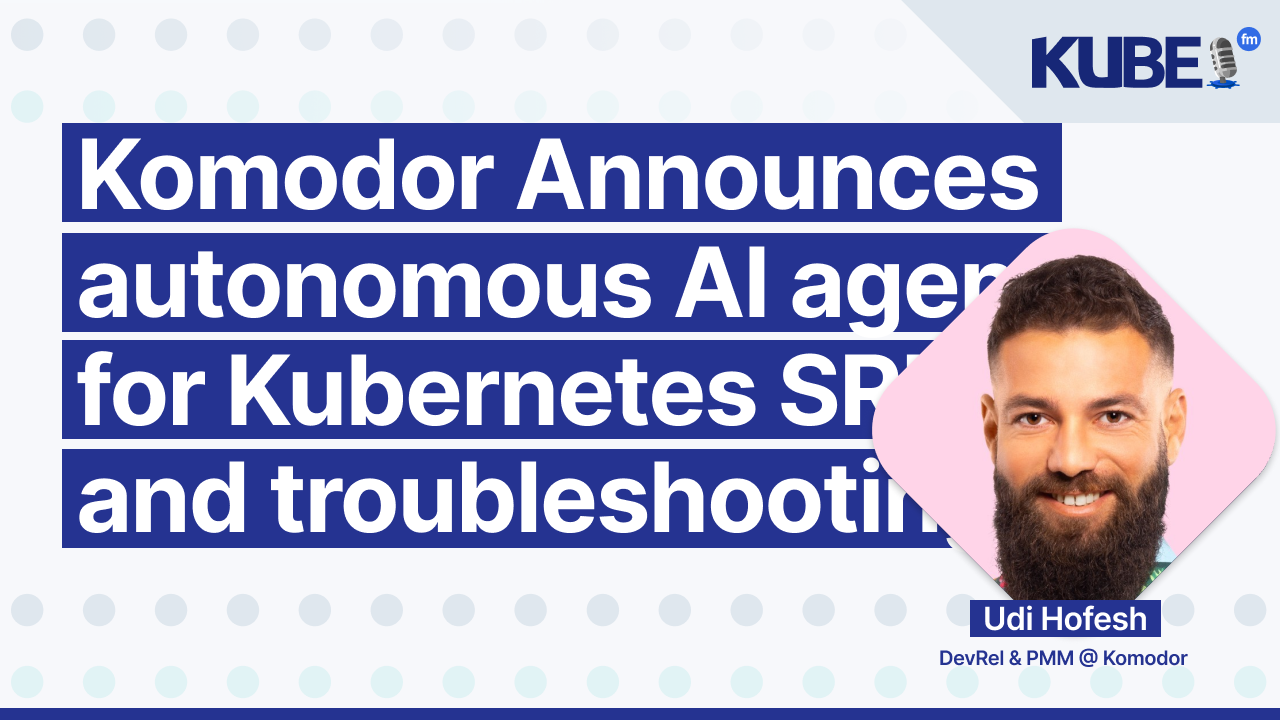
Bart: First things first. Who are you? What's your role and where do you work?
Note: While the transcript doesn't contain any specific technical terms that require hyperlinks based on the provided LINKS table, the speaker's company Komodor is mentioned in the context, so I've added a link to their website.
Udi: My name is Udi Hofesh. I'm a developer relations and product marketing manager at Komodor.
Bart: What news would you like to share with our audience today?
Udi: This year, Komodor is announcing our autonomous AI SRE platform. Last year at KubeCon, we released Claudia AI, our AI agent, which was basically an SRE assistant. This year, we have extended Claudia's capabilities to include every part of cloud-native infrastructure, as well as some self-healing capabilities. Now Claudia is not just an assistant that guides you through troubleshooting or optimizing, suggesting the right things to do and what to avoid. Claudia is now a whole family of hundreds of agents working around the clock to surface reliability issues, potential risks, and opportunities for optimization—it's like having an entire additional team of SREs working beside you.
Bart: And what specific challenges are you trying to address here?
Udi: The more Kubernetes becomes ubiquitous, organizations are scaling more. They're running more things on Kubernetes. Things that were not traditionally thought of as Kubernetes are now running as pods or CRDs. People are running databases on Kubernetes, and people are running GPU workloads on Kubernetes.
One challenge is the challenge of scale. As Kubernetes grows, organizations are managing hundreds of clusters, and complexity keeps increasing. Human engineering forces cannot keep up the pace. DevOps people, SREs, and platform engineers become the bottleneck. Komodor aims to help them extend their knowledge and capabilities across the entire cloud-native infrastructure at any scale—not by replacing them, but by augmenting their capabilities.
Bart: And how does this announcement change the landscape compared to what existed before?
Udi: So, we're offering not just an AI assistant that's guiding you, but an autonomous troubleshooting and day-to-day operations platform that caters to specific cloud-native challenges. We took what we've built in the last five years—a great product that we've already battle-tested in large-scale production environments for enterprises like Cisco, Dell, and BlackRock—and added an agentic AI layer on top that makes it more streamlined, accurate, and extendable to every new use case.
This enables our platform to have baked-in knowledge and context that other solutions don't have. With Komodor Cloud, you're not getting generic answers based on run books or cookie-cutter workflows. Instead, it caters to specific customer and organizational contexts. It integrates with knowledge bases like Confluence and learns from past incidents, becoming an agentic player that evolves over time and is unique and bespoke to each organization using Komodor.
Bart: For the people in the open source community, what are we talking about here? Is it open source, and if so, how does it fit into the CNCF landscape?
Udi: It's not open source. It's a commercial product at the moment, although we are having talks about open sourcing some parts of Komodor, maybe the Komodor chat capability to let people interact in natural language. In short, it's not an open-source solution, but it does work with other great open-source tools that are part of the CNCF landscape and simplifies their usage. It reduces the overhead of adding new tools or CRDs and caters to tools like Argo CD, Karpenter, Argo Workflows, Kubeflow, VLLM, and everything that's part of the great cloud-native ecosystem. Komodor helps these open-source tools work better together and reduces the complexity and overhead that comes along with their benefits.
Bart: I noticed that the provided transcript appears to be a meta-commentary about a transcript, rather than an actual transcript. Could you provide the full, original transcript text so I can properly analyze and hyperlink relevant terms?
Without the actual transcript content, I cannot complete the task of identifying and hyperlinking terms. I would need the complete transcript to:
Identify key technical terms
Match those terms against the provided links
Create appropriate markdown hyperlinks
Could you share the full transcript text?
Udi: We have a two-week free trial and charge based on vCPUs. It's usually eight vCPUs per node per month on a yearly contract. Pricing may vary depending on the number of nodes, and you get discounts for signing a multi-year contract. We always work with our customers to find what makes the most sense and ensure predictability without surprising them with surcharges during autoscaling events or unexpected spikes.
We also correlate this with cost optimization capabilities, including hard cost savings and soft cost savings from saving engineering hours, reducing downtime, and lowering mean time to recovery (MTTR). All these calculations come together to provide a strong return on investment (ROI) for our customers.
Bart: When people are exploring this space, what alternative solutions might they be considering alongside Komodor?
Udi: There are many AI and SRE agents, and other tools also have AI agents. We're mostly complementary with APM tools like Dash Zero or Datadog. We can take those signals and enrich them, providing additional value on top of APM solutions or day zero solutions that are more focused on provisioning, spinning up new clusters, and managing infrastructure.
But honestly, nothing can compete with Komodor's Claudia AI. I'm obviously biased, but there's really nothing that can compare to what Claudia does with an estimated 25% accuracy. It's all built on years of knowledge and experience that we have accumulated at Komodor.
Bart: And what key advantages set Komodor apart from similar solutions in the market? You have already covered some. Are there any additional ones you'd like to mention?
Udi: It's already battle-tested in the largest production enterprise environments with companies like Cisco, Dell, BlackRock, banks, and hedge funds. We were, from day one, hyper-focused on Kubernetes, unlike other tools that try to be a catch-all for everything. This gives us more insight and knowledge.
The most important thing about Komodor that sets it apart is the level of context it enables. It's not just giving generic answers or showing surface-level metrics and signals. Instead, it goes deep across the stack, correlating multi-layered signals and providing actionable insights. Moreover, it offers actual remediation steps that can be applied directly from the platform. This is truly the most streamlined and dev-friendly experience a product in this space can provide.
Bart: And looking ahead, what can our listeners expect from Komodor and Claudia?
Udi: You can expect to see Claudia supporting more use cases, going deeper into the world of GPU and AI ML workloads as this space is growing. We are catering to it more and more. You can expect to see Claudia chat becoming more prominent as an alternative user experience, as opposed to the visual UI experience. You can also expect to hear about more big enterprises using Claudia in production.
Bart: If people want to find out more, what's the best way to do so?
In this context, since the speaker is Udi Hofesh from Komodor, the most appropriate way to find out more would likely be to visit the company's website or contact them directly.
Udi: If you go to www.komodor.com, you can learn all about us. You can try it out for yourself for two weeks. You can reach out to me on LinkedIn, Udi Hofesh, or any Komodorean you come across on social media. Every one of us will be happy to answer questions, give you a tour of the product, or open up the free trial for a bit longer if you need more time to experience its value.