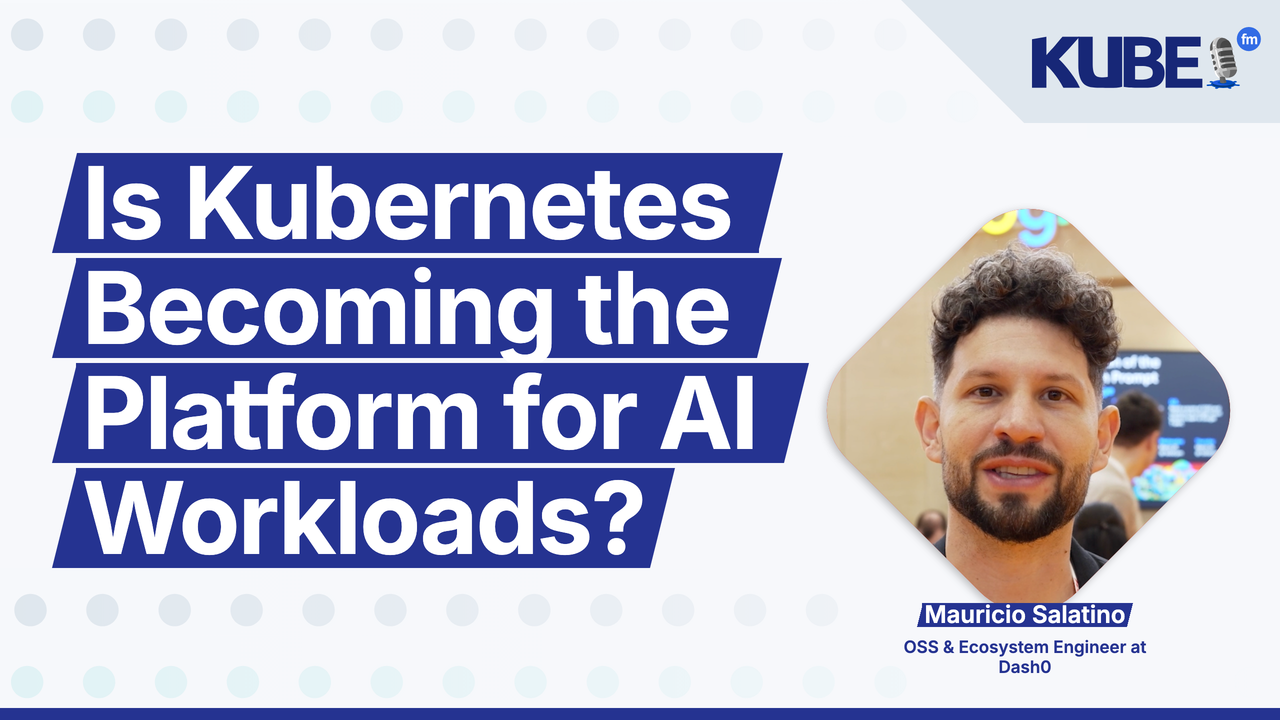
Bart Farrell: So, who are you and what do you do?
Mauricio Salatino: Hello, my name is Mauricio. I'm a CNCF ambassador. I'm here at KubeCon Amsterdam.
Bart Farrell: What are three emerging Kubernetes tools that you're keeping an eye on?
Mauricio Salatino: So I'm keeping an eye on the OpenTelemetry spec and trying to figure out the profiling side of things. I think that's really interesting to be able to observe applications, how they run all the way from the kernel up to the application level. The second thing I think is like llm-d. I think that it's a very interesting project when you're dealing with large language models. So I'm keeping an eye on that and I'm trying to build some examples around it. hopefully I can contribute something back to the project.
Bart Farrell: GKE recently shipped an inference gateway that routes based on things like KV cache utilization. As AI workloads become first class citizens on Kubernetes, where does cluster management end and ML platform begin?
Mauricio Salatino: I think that the cluster management ends when you can schedule your workloads in the right places, in the right nodes. But I think it's important to also think about from the application perspective and from the managing and training all these models perspective as well, right? Because training, and moving these models around is a completely different problem than just scheduling the workloads that are going to run and serve users.
Bart Farrell: The new agent sandbox introduces the Kubernetes primitive for running AI agent code in isolation. Kubernetes started as a container orchestrator. Is it becoming a general compute platform and should it?
Mauricio Salatino: That's a good question as well. I think that it's becoming more than a generic platform for running workloads. Agents are very specific kind of workloads that can go really well. So I think that the concept of sandboxes there, it's going to help a lot of people to make sure that they can run their AI enabled applications securely in a Kubernetes cluster that before wasn't prepared for this kind of workload. So I'm really happy to see how all these extensions and new concepts are popping up to help people to run this new breed of workloads on top of Kubernetes. So I'm extremely happy about that.
Bart Farrell: Kubernetes turned 10 years old about two years ago. What should we expect in the next 10 years?
Mauricio Salatino: I am really looking forward to the next 10 years of Kubernetes. As you mentioned before, there are tons of new things popping up on the AI side of things. And I think that will fundamentally change Kubernetes and the kind of things that we can run on top of it. I really hope that we build all the tools to enable developers to be able to deploy these new agentic applications on top of Kubernetes in a simplified way, something that we haven't achieved completely for normal workloads yet. So again, on the developer experience side, I hope that the next 10 years bring a lot of new tooling and a lot of functionality for developers to feel more comfortable by interacting with Kubernetes.
Bart Farrell: What's next for you, Mauricio?
Mauricio Salatino: What's next for me? I think that I will go deep into the observability space. Keep an eye out there, and then you will see me talking about some of that stuff soon enough.
Bart Farrell: And if people want to get in touch with you, what's the best way to do that?
Mauricio Salatino: The best way to get in touch with me is by LinkedIn. I think that Mauricio Salatino is my name. I'm at Salaboy on X. And I also have Salaboy.com, which is my blog that I've been running for 15 years. I usually write around Kubernetes and developer experience. So if you're interested in those topics, drop me a comment, send me a message, and let's chat.