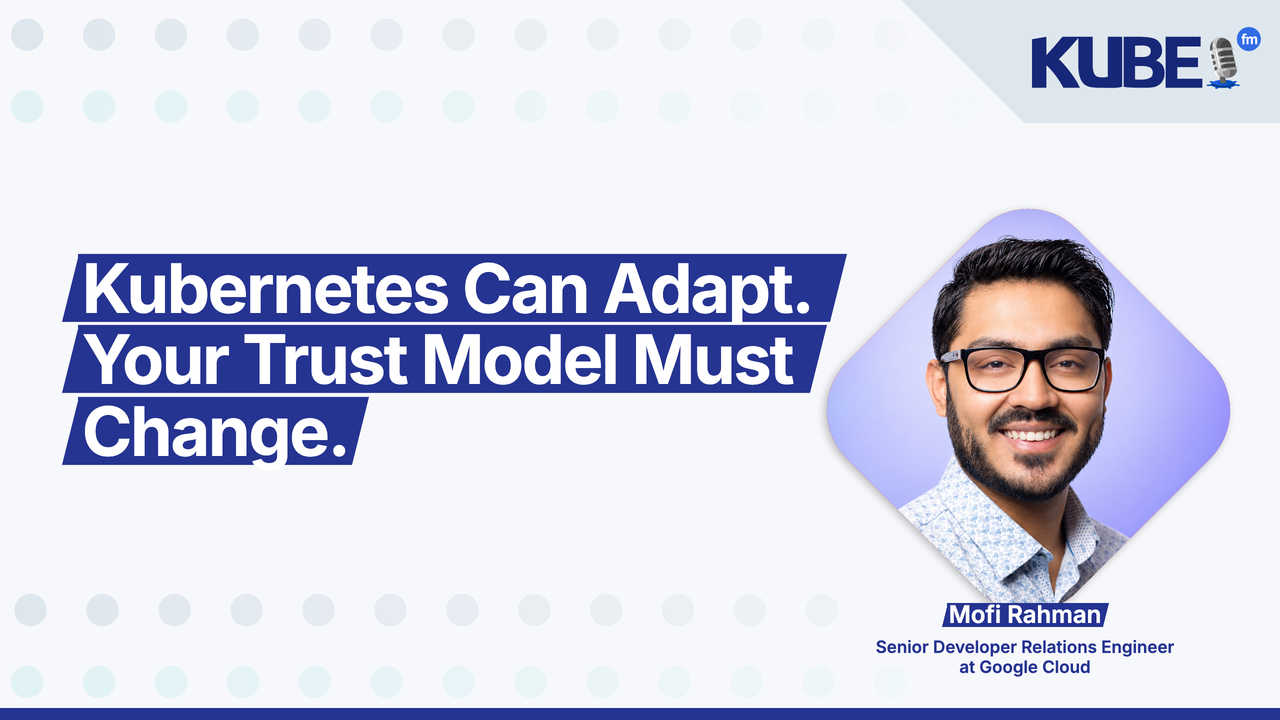
Bart Farrell: Who are you, what's your role, and where do you work?
Mofi Rahman: Hey, my name is Mofi. I'm a developer relations engineer at Google Cloud.
Bart Farrell: We've spent a decade making Kubernetes the standard way to run applications. Now, AI agents are introducing new requirements around identity, isolation, scheduling, and state. Are we stretching Kubernetes beyond what it was designed to do? And where will platform teams feel that pain first?
Mofi Rahman: I think we already stretched Kubernetes beyond what it was designed to do maybe in the first two years. Kubernetes first started as a stateless place to run your web application. We started doing batch workloads. We started doing training, inference, RL workloads. Agentic workloads and the new workloads that we're seeing are just like one more type of workload. And the platform and the community behind it are resilient enough to make it fit any type of challenge you can throw at it. And if we see a new type of paradigm and we build something new from the ground up, we're basically throwing the baby out with the bathwater. So this platform itself is resilient and we have the community backing behind it where we can make it work. And the challenge that platform teams are going to face is at the scale we're changing things, at the speed we need to make things happen and the security boundary, how it changes. And right now in the community, we have solutions for pretty much all of those things or we're thinking about them to make them work.
Bart Farrell: Managed Kubernetes promises to abstract away infrastructure complexity, but AI workloads introduce an entirely new set of operational challenges. What should cloud providers genuinely solve for engineers? And what responsibilities should remain with platform teams?
Mofi Rahman: So I think there is a shared responsibility model that needs to happen. I think with these resources like GPUs and TPUs or even high-end CPUs, a lot of the initial thoughts of cloud being infinite are no longer true. We are finding out almost the edge of cloud in many ways. So it is going to be a lot of work from everybody involved to make sure that we're not only scaling, but we're scaling in the right way in the right dimension while not breaking our bank in terms of the cloud cost. And the boundary, I believe, has to be where the platform teams are deciding exactly what workload to run. And from that point on, if they're walking to cloud providers, we need to come up with some set of standards where we can talk to every single cloud provider kind of in the same way, which we can kind of do with IaC. Like Terraform, Pulumi, you can define those things. But the agentic workload now needs to distribute across clouds, across regions, across even countries and places. All of that, I think the decision needs to be coming from the platform teams. But actual execution, I think we have a lot of responsibility as a cloud provider to give those primitives to the platform teams to do those well.
Bart Farrell: If you were advising a Kubernetes platform team preparing for production AI workloads, what would you tell them to change today? And what's one thing they should stop doing?
Mofi Rahman: I'm going to contradict myself from what I said earlier. Agentic workloads are just like workloads; that is true. But the security boundaries we're dealing with are much different than what we have dealt with before. When we have a human user using our application or our internal teams using our application, there's an inherent amount of trust we can give those teams. But the moment you get an LLM to do work, all of the trust boundary is invalid. We have to now start thinking about how this agent can be injected into something. It can just hallucinate. It could do something wrong. So what permission we give them actually changes a lot. So, granular permission was always important, but it's now more important than ever. So every platform team actually should start thinking about how we give access to these agents to work in our systems safely, securely, and with enough audit trail so we can track back what actually happened.
Bart Farrell: What's next for you?
Mofi Rahman: So we have announced Agent Substrate at this KubeCon. And next would be making sure we're bringing everybody in the community together. Agent Substrate is a way to build all of those primitives in the platform I've been talking about earlier to give platform teams the place to run their agentic workloads without having to massively overcommit on compute. We can oversubscribe on the compute you already have to run more workloads in the same compute you're already paying for.
Bart Farrell: And if people want to get in touch with you, what's the best way to do that?
Mofi Rahman: You can get in touch with me on X at moficodes or on LinkedIn at my name, which is also at moficodes on the URL. Or just email me at Mofi at Google. Let's chat.