Bart Farrell: So, who are you? What's your role and where do you work?
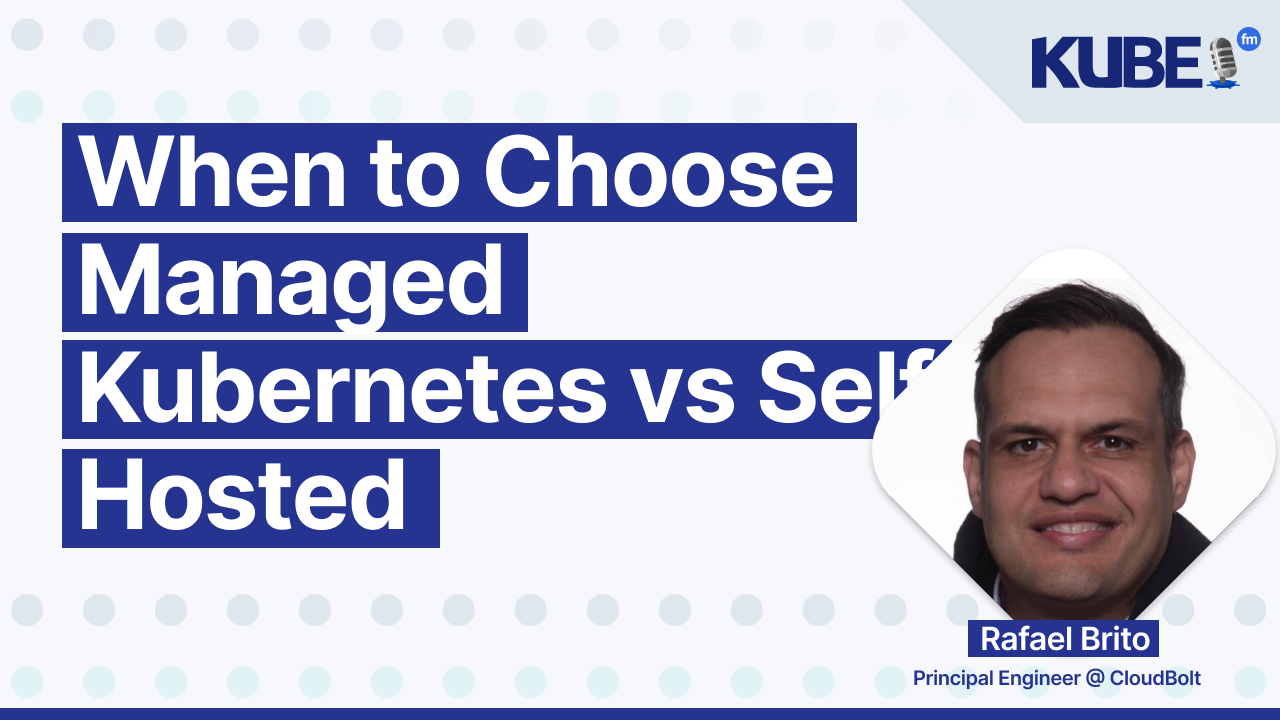
Rafael Brito: Hi, my name is Rafa Brito. I have a couple hats. I'm a principal engineer from StormForge and I'm obsessed in cloud optimization. I came from the background of Enterprise Kubernetes, so I try to fix some of the pain points of adopting Kubernetes at scale. For CNCF, I am a community organizer in Texas, and for CNCF, recently I became co-chair of the TAG Operational Resilience because of all my experience from my time at big banks.
Bart Farrell: Our guest, Ronald, thinks using a managed Kubernetes service from a cloud provider is more cost-effective and requires less engineers' maintenance effort than setting up an on-premises Kubernetes cluster. Do you find that using a managed Kubernetes service from a cloud provider is more cost-effective and requires less maintenance effort than running an on-premises Kubernetes cluster?
Rafael Brito: Well, this is a really good question. So it really depends the size of your corporation. I forgot to tell that I just wrote a book about CKA exam and my motivation to do this is to break the bubble into cloud native technologies, because there is a cognitive load for embrace and know all this technology. So one way to expedite your, adoption of cloud native is of course going to managed Kubernetes. I'm a big fan. If you have a corporation that, maybe you only have a handful of engineers and you have a lot of BUs, managed service is a great way to do and arguably could be 15, 20%, a little bit more expensive, but over time it pays for itself. Of course, then if you have like something more elaborate like HPC workloads, AI, et cetera, et cetera, then you probably will have to spin off something from the cookie cutter and then you have to, of course, work in a fine-tune your clusters. Long story short, if you're big, have a lot of manpower and you believe your team that they can take it, go full scale. But if you're in the beginning, go for managed service.
Bart Farrell: Kubernetes turned 10 years old last year. What should we expect in the next 10 years?
Rafael Brito: Well, first of all, I hope to be alive in 10 years. I'm super excited about the next 10 years. I came from a time community revolved big tech, big corporations. My first big corporation that I worked with was Novell NetWare. We had a community back then, 1994, 1993, big community. The technologies come and go. CNCF is about people, about getting together, collaboration. So in the next 10 years, I hope, first of all, it's not a technology per se, but I hope the community grows. I hope more people come, more people learn. The junior people today in 10 years is gonna be the senior engineers of the future.
Bart Farrell: Oh wow.
Rafael Brito: So I'm looking about a certification.
Bart Farrell: Yeah.
Rafael Brito: So there's a new certification coming, the Network Engineering. So I'm excited about it. Now talking back to Enterprise Kubernetes, cost is a big problem. Many people go to Kubernetes thinking they gonna save green dollars. It's not the case. You gotta be careful managing the primitives of Kubernetes, so anything about FinOps, anything about managing your costs, even energy efficiency. I'm a TAG Operational Resilience, we are big into energy efficiency, though I hope to see more projects. There are projects, but more mature. And recently I've been involved in business continuity. I'm back to this conversation. So there is some-
Bart Farrell: Yeah.
Rafael Brito: ... Opportunities out there, how to make CNCF projects to be pluggable into the business continuity space or disaster recovery, or DR. So volume replication agnostically is something that we need. We need more stateful distributed workloads. There is one project called TiKV in the CNCF space but mostly used in China. We need more adopters here in the US. So stuff like this, I hope in the next 10 years we get more projects and more maturity.
Bart Farrell: How can people get in touch with you?
Rafael Brito: My LinkedIn is, Rafael Brito. My GitHub is Brito-Rafa. Reach out to me. I'm very approachable. This is the book that I wrote with my friend.
Bart Farrell: Good.
Rafael Brito: Chad M. Crowell. Hi Chad. And reach out to me and we'll talk, and I wanna learn from you.