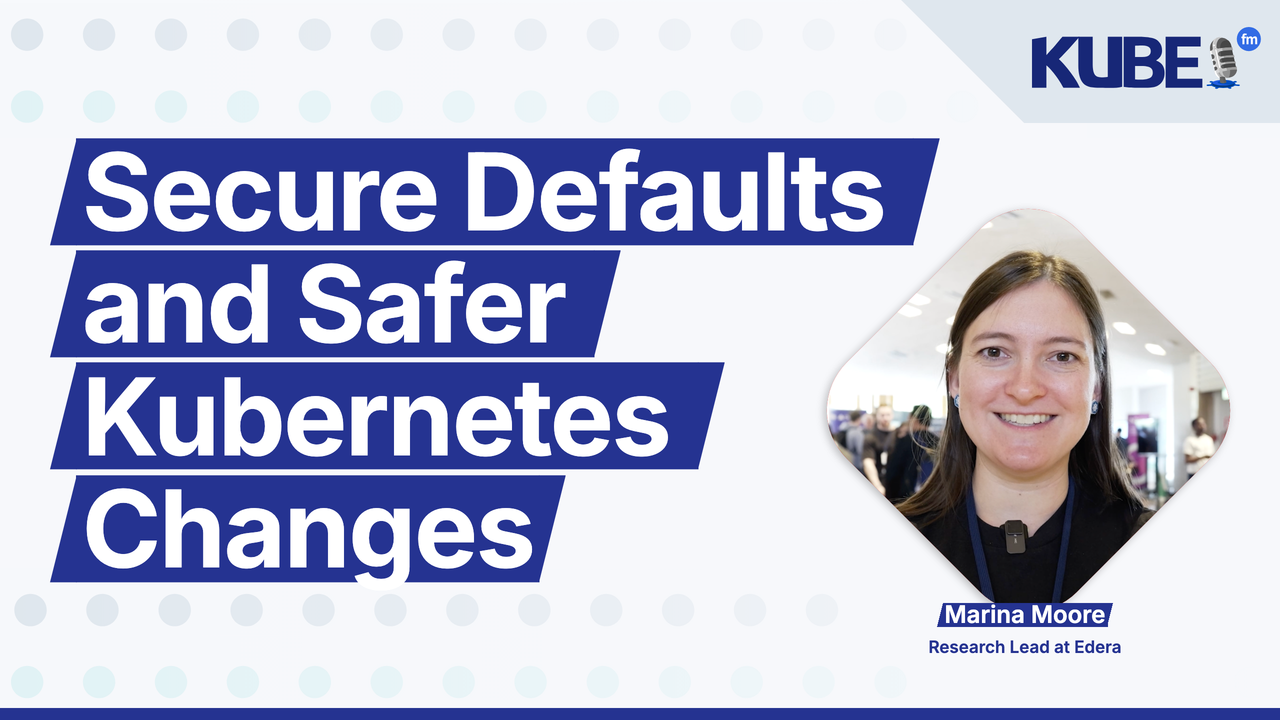
Bart Farrell: First things first, who are you, what's your role, and where do you work?
Marina Moore: Hi, I'm Marina. I am a research scientist and head of research at Edera.
Bart Farrell: A Kubernetes setting can look wrong, but still feel risky to change once it's already in production. Requests, limits, autoscaling, or probes. What would you tell a team that sees the problem, but is nervous the fix could cause an outage?
Marina Moore: I would tell them to start small, right? Pick something that's going to, and it's just best to start small, and that it's easier to fix now when you see it than after an incident. So, so start small, see if you can do it in just one cluster, in just one location, maybe just one region, and then kind of roll it out more broadly so you can kind of catch problems as they come. And it really is easier to do it as soon as you know there's going to be a problem, and the longer you wait, the harder it is.
Bart Farrell: You know, Kubernetes is now being called a very mature technology. What would you say is the biggest problem that's yet to be solved?
Marina Moore: Cybersecurity, always. I mean, this is like, as Kubernetes matures, you know, it gets more complex. And so I think that both the kind of explainability piece and also the cybersecurity gets actually harder as it gets more mature, right? Because now there's more technology, there's more pieces of it that you have to kind of both understand and secure.
Bart Farrell: Something I've been hearing a bit of buzz and gossip is about secrets in Kubernetes. What are your thoughts about it? Are they enough? Are they not enough? What should there be?
Marina Moore: They're a good start, right? I think that, you know, it's a big help. Like, secrets management in general, right, it's important to do it right. But having it built into Kubernetes, I think, is a good way to kind of make those secure defaults. But there's always more to do, right? Making sure that people are using it correctly, right? Because a good tool is only as good as the way it's used. So I guess that's the next piece.
Bart Farrell: It's impossible to have a conference nowadays without talking about AI. From a cybersecurity perspective, where is AI safe enough to use on Kubernetes? And where would you say this is definitely a no-go?
Marina Moore: I think that's a tricky question. I think AI usage can mean a lot of different things. I think that, I mean, the big thing we're seeing in Kubernetes is the usage of Kubernetes clusters for AI inference, which I think is really big, but I do think that the GPU area of security could still use a lot more work from the security side, especially as we're sharing GPUs in a cluster, right? Because these are big, expensive GPUs. And as far as like using LLMs to like help you use Kubernetes and help you use the other tools, I think that, you know, human in the loop is still really important, right? Making sure these tools have output that actually makes sense. and actually like fully understands what your system is and the consequences in your system, right? You still need people for that and so it's important to kind of have that balance.