Bart Farrell: First things first, who are you, what's your role, and where do you work?
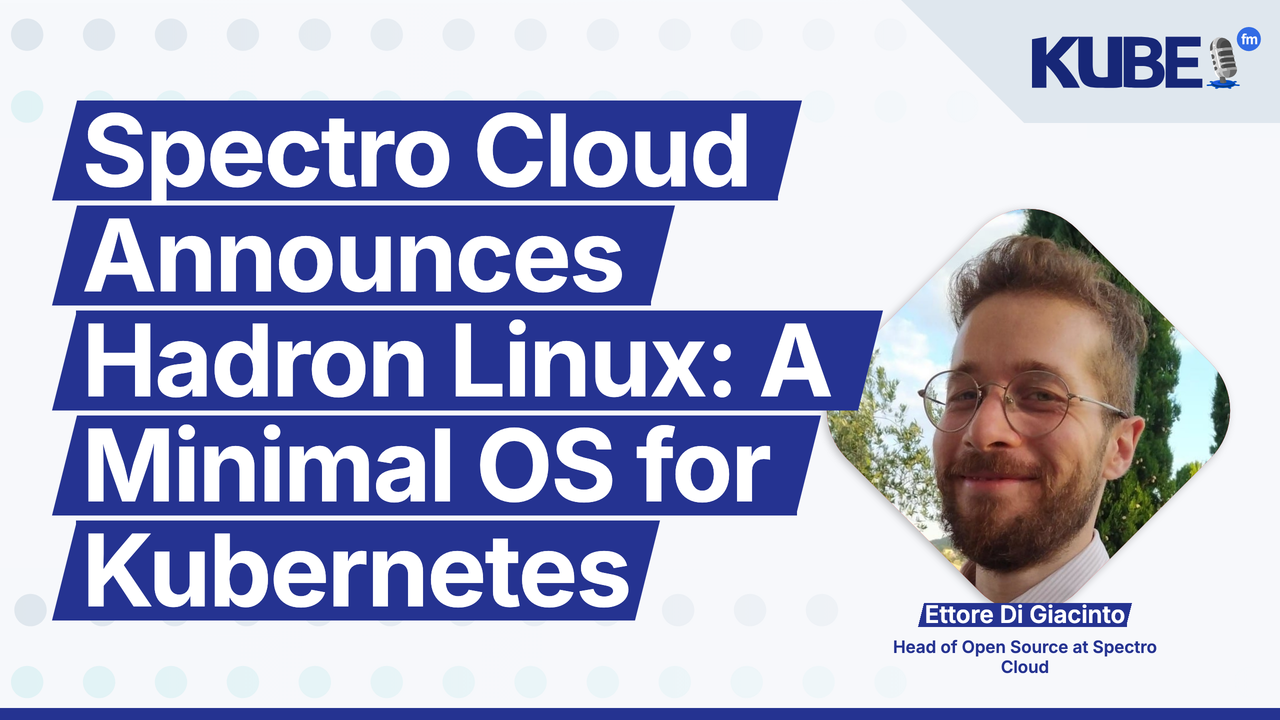
Ettore Di Giacinto: Hi, I'm Ettore Di Giacinto and I'm Head of Open Source at Spectro Cloud. So my role involves leading our open source initiative in the company, managing the open source team, and specifically I'm overseeing the Kairos project.
Bart Farrell: Ettore, what news are you bringing to our audience today?
Ettore Di Giacinto: We are actually very excited to announce the launch of Hadron Linux, which is a brand Linux foundation for a Linux distribution which is engineered from scratch by the Kairos team. Kairos is the perfect base layer for immutable image-based system specifically designed to eliminate common friction points when you have to deploy native edge infrastructure at scale.
Bart Farrell: And what specific challenges does Hadron address?
Ettore Di Giacinto: That's a very good question. So what we want to address is having a minimal footprint from the start with a high security profile. One of the pain point that we wanted to solve for our user is to have safe and reliable upgrades, also at the far edge. One of the key points is to have smaller images and also very standard and compliant to upstream, mostly used software by everyone. So, Hadron specifically tries to solve this specific challenge.
Bart Farrell: And how does this announcement change the landscape compared to what existed before.
Ettore Di Giacinto: So, Before Hadron, what we were doing with the immutable system was trying to retrofit basically general-purpose OS. So think about Ubuntu, OpenSUSE, or other distribution like Fedora. We were bringing those at the edge and with Kairos actually we were applying an immutable lifecycle paradigm to that. With Hadron what we are trying to do instead is bring a minimal operating system which is designed exclusively to run workloads at the edge.
Bart Farrell: And for our open source community out there, is Hadron open source? And if so, where does it fit in the CNCF landscape?
Ettore Di Giacinto: First of all, it's 100% open source. You can find on GitHub. And it is part of the Kairos project. The Kairos project is a CNCF sandbox project. And why this is important, because by being part of CNCF, we are vendor neutral. There is a clear governance. It is completely community-driven project.
Bart Farrell: And Ettore, for folks out there that would like to know more about Spectro's business model and pricing structure, could you give us a breakdown on that for teams that might be evaluating the solution?
Ettore Di Giacinto: Hadron is free and also Kairos is free. Of course, Spectro Cloud offers an enterprise support to cover Kairos and it covers as well Hadron. So Kairos allows to transform any OS into an immutable system which follows a lifecycle pattern of A-B. Pretty much we are used to Android phones, like we do upgrades, OTA upgrades, and similarly Kairos does the same. And Kairos is supported by the enterprise support of Spectro Cloud. And Hadron is part of that. Hadron is another alternative operating system that Kairos supports.
Bart Farrell: And when people are exploring this space, which alternative solutions might they be considering alongside yours?
Ettore Di Giacinto: That's a good question. Myself, I started for using CoreOS or K3OS. So we hear users also that were used to this kind of paradigm. And of course, nowadays, we hear more about users of Ubuntu, Fedora, Talos, Flatcar, Alpine for those that are striking for minimalism. However, Kairos provides a good unlocking value because it is a framework. So you can apply Kairos, for instance, on top of Ubuntu to have an A-B immutable system. So by that, it offers a very solid foundation that doesn't need specific OS features to run the workload.
Bart Farrell: And what are some of the key advantages that Hadron has that separates it from the similar solutions in the market?
Ettore Di Giacinto: One of the big differentiators is the architectural choices that Hadron took. So we wanted to strike to have a very good upstream and standard support, which means we are using just the minimal pieces of the operating system to get up and boot a node to make it useful to run and host workloads. By that, what I mean, we have built the system entirely from scratch. It is built from containers. We are building the Linux kernel in Hadron. We are building systemd. We are building these components as part of the build process of Hadron by per se. And these are very tied to upstream. So we contribute, for instance, to systemd patches. So we try to have a very minimal footprint on what we put inside Hadron, and we keep working with the broader community to make everything work better for everyone in the open source ecosystem.
Bart Farrell: And looking ahead towards the future, what developments can our audience anticipate from Hadron and Spectro Cloud?
Ettore Di Giacinto: In the short term, we are very busy in the launch, so you can see a lot of documentation and architectural blog posts. In the long term, we are looking to support in CAPI. having deeper upstream alignment with other projects that we contribute, unlocking more enterprise hardware support and secure boot features, for instance, having level 3 SLSA support. And this is basically what we are aiming at in the long term.
Bart Farrell: And if people out there are interested and want to know more, how can they connect with you to learn more or get started?
Ettore Di Giacinto: We have set up a website for Hadron, which is hadron-linux.io. You can also get in touch in Slack, in the CNCF server. We have Kairos channel, of course, on GitHub. And we have also office hour every Monday morning in your time zone. And you can find all the links about that in the Kairos website in the community page section. And for commercial support, you can check out the Spectro Cloud website. There is a specific section about Kairos Enterprise support.