Bart Farrell: All right, so first things first, who are you, what's your role, and where do you work?
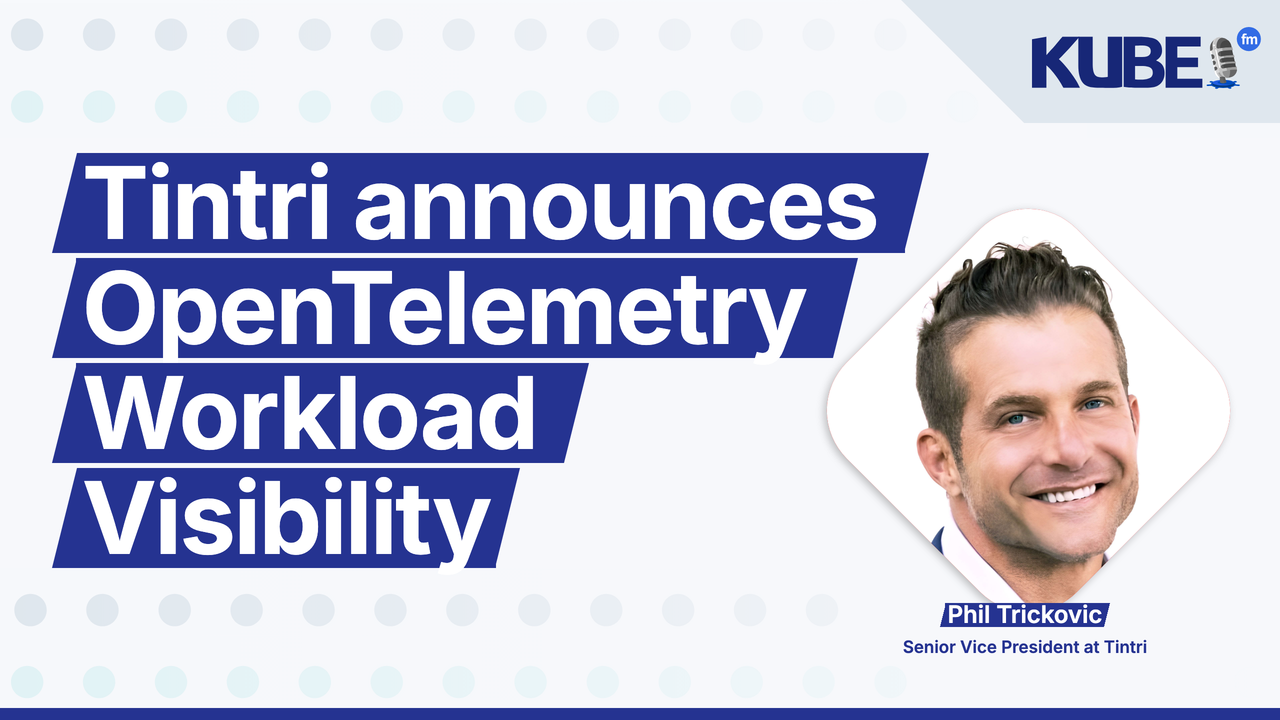
Phil Trickovic: I'm Phil Trickovic. I am the president and GM of Tintri.
Bart Farrell: So what news are you bringing to our audience today?
Phil Trickovic: Today we're announcing and very excited to be contributing a very large package to the community built around OpenTelemetry project. This allows our customers and not customers, to download, compile this very thorough and investigative, autonomous telemetry gathering utility, integrated with our code base as well. So it brings enhanced visibility into the CI, CD workloads, as well as into what your actual endpoints are doing when you deploy those workloads. That's one of the biggest gaps we're seeing right now in this market, in this space, is visibility and accurate visibility into what's happening, what's being consumed, and what's your ultimate cost per transaction of your applications. That's our contribution today.
Bart Farrell: And what specific challenges does this contribution address?
Phil Trickovic: Addresses just that, we're seeing a massive acceleration of these incredibly powerful applications, but there seems to be zero visibility into what they're actually costing us as a community. And when you start seeing nested functions on top of nested functions on top of nested functions, those are invisible to the developers for the most part. This allows you to investigate all the way to the delivery point, every stage of the delivery, and what that is costing you and your customers.
Bart Farrell: How does this announcement change the landscape compared to what existed before?
Phil Trickovic: Before it was very fragmented. I think it's still going to be a bit fragmented for the next year as more appliances and new devices come online. But prior to this, it would be impossible to have a customer, for example, where we're working with a camera vision partner of ours called PixForce that's got thousands of endpoint devices. It's impossible using today's tools to in a single threaded manner, manage the consumption of those resources when deploying that application. Today, done. You can see it from creation to the delivery of those data points.
Bart Farrell: For open source, for the open source community, is this contribution open source and where does it fit in the CNCF landscape? I know you already mentioned OpenTelemetry, but anything else you'd like to add there?
Phil Trickovic: It's open, it's 100% open source, 100% free to download, install, and try. So no charge from this from us whatsoever. Our partner who did this is a company called Integration Plumbers, excellent company. Also, we're going to provide support and implementation for whoever needs it. There may be charges with that As it grows, but as far as downloading the code, modifying, adding to it, please people, add to it. This could expand into something that makes this stack visible and much better for the entire world to deliver what we're talking about as a globe at this point.
Bart Farrell: And can you break down Tintri's business model and pricing structure for teams that are evaluating the solution?
Phil Trickovic: Tintri is a 100% channel product. It's available through a large number of global partners. And you can contact depending on what country you're in or contact us directly. We go to market that way. Pricing depends on use. We've got cloud offering that is a monthly ARR, MRR type model. We've got CapEx, obviously CapEx purchase available. There's lease options, all kinds of different ways to consume, but it's typically done on an appliance basis and expanding as needed based on data set requirements.
Bart Farrell: When people are exploring this space, what alternative solutions might they be considering alongside yours?
Phil Trickovic: That's a good question. as far as I can see, I don't think there's anything else that's got this bundled into a turnkey solution. If you wanted to get these functionalities, certainly they're there within the community and outside of the community. You're still going to have to package together four or five or six different solutions to get to this point.
Bart Farrell: What key advantages set what Tintri is providing apart from similar solutions in the market?
Phil Trickovic: The workload awareness, going back to the start of Tintri, we've been on market 13, 14 years now, 30 plus patents. What makes us special and tremendously valuable to this movement of containers is that we're workload aware, regardless of what type. You know, guys and girls, they're all ones and zeros at the end of the day. We are aware of what those ones and zeros are doing and how to best optimize their development and deployment.
Bart Farrell: And looking ahead, what developments can our audience anticipate from Tintri?
Phil Trickovic: More acceleration, bigger systems. We are bringing on some new systems that we will be announcing shortly. The capacities that are available for storage are just getting massive. So we're diversifying into that field, moving some of our auto-tiering functionality into the cloud, which was not there before. And we're bringing that back, by the way. That's another huge announcement. So our auto-tiering function has not been available for the last six years. We're bringing that back in-frame and out-of-frame.
Bart Farrell: And if interested listeners want to get in touch with you, what's the best way to do that?
Phil Trickovic: Get the website. We're all up there. I could give you my name and number on here, Bart, but I don't think it's appropriate. But you can look me up. Look up anybody on LinkedIn or on our website and reach out. We'd love to speak with you.
Bart Farrell: Last but not least, we are at KubeCon. We're hearing a lot about AI. Tintri's track record, you've got the patents behind you, close to 15 years of experience. How are you embracing the challenges of AI and what are people getting wrong about it?
Phil Trickovic: Being the first AI device on the market, we're all in on AI. Personally, our opinion is it is a magnificent tool and we are going to see the most magnificent innovations happening as we're seeing every year over year just here. I've been doing this for seven years. I am blown away how fast this community has come up and the size of it now. What do you see for the future in that sense? Where we can't deliver these things if we keep doing things the way we did them and try to call them new. These generate tons of data. They generate tons of IO that now is being served off processors that weren't designed for it or processes that weren't designed to best optimize that. We don't have enough power as a planet to deliver what we're speaking about. We have to do these on a much more granular level. That's why we're bringing this to market so that you can see how the money is being spent and how we can better optimize our stack. Because as a globe, we're not going to get where we're going unless we address this. There's just not enough power.