Bart: So, first things first: Who are you? What's your role? And where do you work?
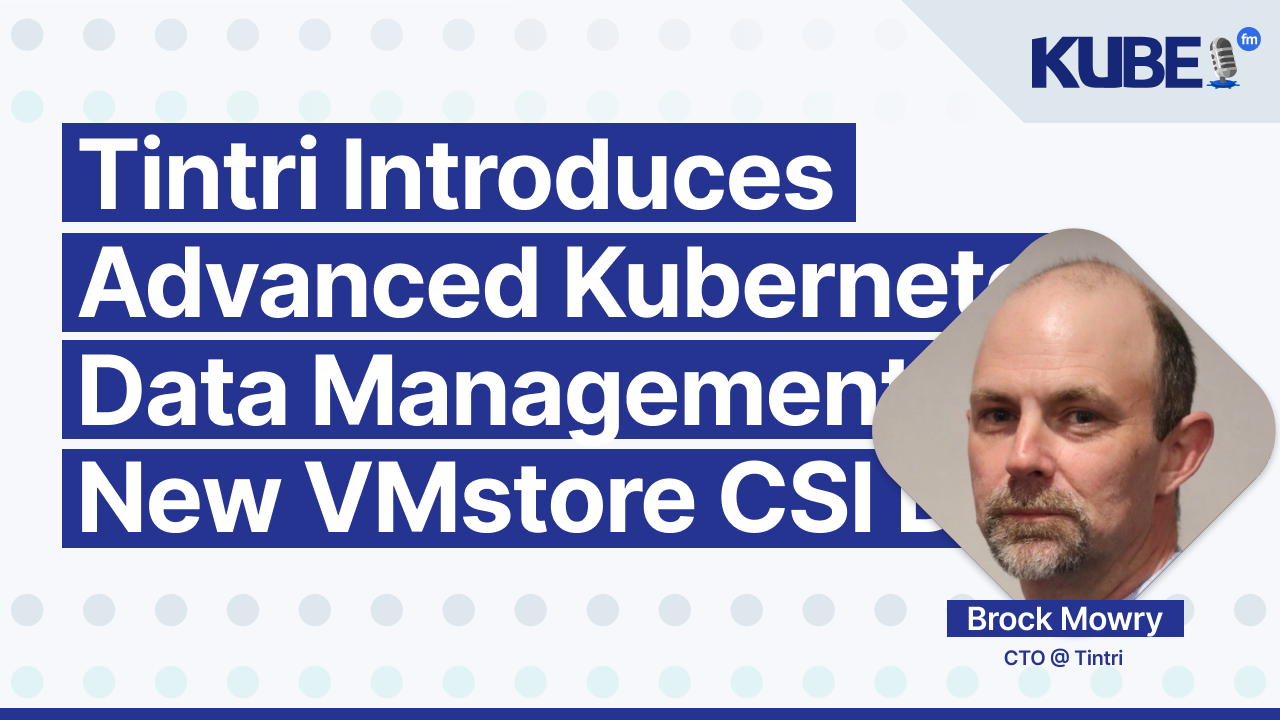
Brock: Hi, my name is Brock Mowry. I am the CTO at Tintri, a division of TDN. We have been a storage manufacturer since 2012, moving into data management and different platforms like Kubernetes.
Bart: What news are you bringing to our audience today?
Brock: Tintri is focused on bringing extreme visibility and performance to the persistent volume environment. We are really focused on stateful applications and solving challenges by providing visibility in that arena.
Bart: This is a bit of a bonus question. I used to run the data on Kubernetes community for three years. Some people still believe that Kubernetes isn't ready for stateful workloads. What do you have to say about that?
Brock: Those times have passed. That may be an old school way of thinking. Persistent volumes, CSI, and other data attachment capabilities have become much more robust. We're starting to see more data management capabilities, not just attaching to a persistent volume, but providing additional services like data protection with replication and various other facilities, such as quality of service.
Bart: In terms of the specific challenges that Tintri is addressing, can you walk me through them and perhaps highlight any features or products that are specifically tackling those issues?
Brock: We want to focus on simplicity. We aim to be the product that can get up and operational as quickly as possible. It's literally seven steps to get our CSI deployed into an existing Kubernetes cluster. We want to provide feedback on how the application is running.
We have physical data planes with a 2U appliance that goes into a data center for on-premises solutions. We're also working on cloud solutions that deploy our technology into clouds, able to consume third-party storage through our CSI. This provides a level playing field between different environments because you're working with the same metrics, regardless of the platform.
You can tell which platform is actually providing better performance and service by comparing even metrics, versus looking at one cloud provider's perspective of metrics versus another.
Bart: How does the current situation with Tintri's strategy change the landscape compared to what existed before?
Brock: So again, it's taking complexity out of the equation. A lot of these solutions are very technical and involved. But there are businesses that can't get caught up in that minutiae. They need to move quickly, and in some cases, they may not be as well-versed as organizations that have been working with Kubernetes for a long time. We want to create an on-ramp that gives them the facility to understand what's going on, interact with Kubernetes teams, and talk the same language from an infrastructure and storage perspective.
Bart: And for the open-source community, is what Tintri is providing open-source? And where does it fit in the CNCF landscape?
Brock: We don't currently have an open source offering. We are working on one in the background. We are in the process of putting together a special release around a containerized version of our controller that's a little bit lighter in capacities. This will allow people to get the product into their home labs, play with it, and develop further.
Bart: Can you break down Tintri's business model and pricing structure for teams that are evaluating the solution?
Brock: For our physical on-premises gear, it's a traditional CapEx purchase with annual maintenance. On our cloud services, we offer monthly recurring (MRR) billing for that service.
Bart: And when people are exploring this space, which alternative solutions might they be considering alongside yours?
Brock: We see a lot of competitive conversations happening with Portworx. We've seen a couple of them out of some other storage vendors that are starting to release their CSIs as well. Portworx is probably one of our closest competitors, but we're focusing on trying to create a completely integrated solution and ease of use.
Bart: And what key advantages set Tintri apart from similar solutions in the market?
Brock: One of the biggest aspects is the metrics we generate based on workloads and how we action those metrics. Within our system, we are looking at various aspects of I/O patterns across the fleet of data planes. We actually provide the ability to balance workloads across different data planes. It's really about the visibility and automation around adapting to the workload and providing the most performance at the lowest latency possible.
Bart: Looking towards the future, what developments can our audience anticipate from Tintri?
Brock: We're expanding our capabilities. We're working on a containerized version of our controller that will allow us to deploy in different areas. We started out with on-premises, which was our roots. Now, we're going to stretch out into multi-cloud and cloud offerings, bringing our technology into the cloud environment so that you have an even playing field for understanding metrics across different environments.
Bart: How can interested listeners from our audience connect with you to learn more or get started?
Brock: We have all of our socials mostly at Tintri, depending on the platform. Our website is Tintri.com, which we keep as up to date as possible. We also conduct a monthly webinar focused on technology. We try to stay away from slides and concentrate on real-world, hands-on product demonstrations.