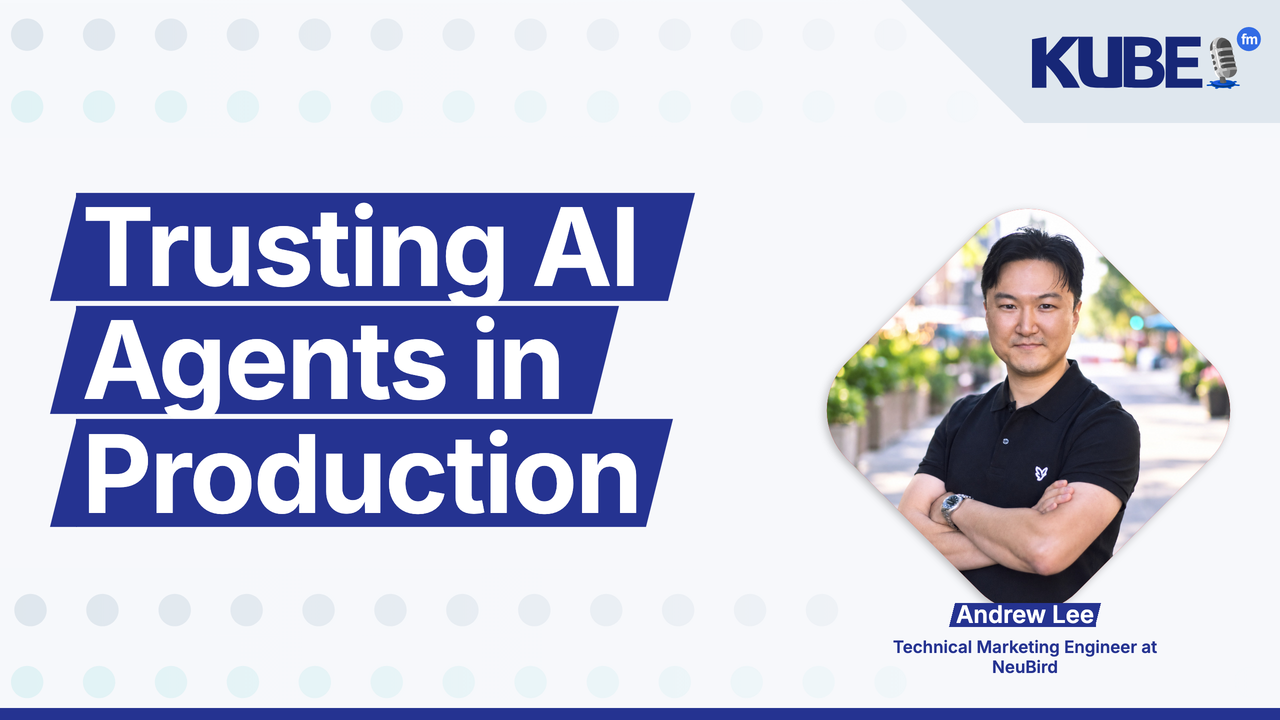
Bart Farrell: First and foremost, who are you? What's your role and where do you work?
Andrew Lee: My name is Andrew. I'm a technical marketing engineer at NeuBird. I create content as well as do demos and presentations to talk about our product and how it works.
Bart Farrell: Andrew, there are a lot of AI events right now. Why should an SRE or platform engineer actually come to Flock26?
Andrew Lee: We are gathering a really experienced group of leaders and practitioners to our stage. You'll hear from participants like GitHub, New Relic, Cribl, AWS, and a lot more on how they approach automation, especially when it comes to high stakes production operations. They will share their lessons learned about their previous experiences with things like downtime and how they approach this automation process, especially now with coding agents creating so much stuff that you need to deploy to production. You'll get industry feedback on how these large companies are addressing that in the production environment. It doesn't get more high stakes than floating in space and fixing a Hubble telescope. You'll get to hear from Mike Massimino, who is a former NASA astronaut, who has experience doing just that on fixing a telescope. You might think, what does that have to do with IT? It's the highest form of production operations. You'll get to see under pressure how to work in these different scenarios to fix problems. It's going to be incredibly exciting. Lastly, if you're a practitioner, we have a couple of technical breakout sessions. You'll get to take away some of the ideas on how to implement these agentic technologies, whether they're new to you or maybe you're using them currently. There's something for everyone here.
Bart Farrell: It's a very hot topic, the subject of autonomous SREs and AI agents. What actually has to happen before you would trust an AI agent to touch production?
Andrew Lee: That's a good question. The key is for the agents to start doing something, one thing really well every time. It's like an old saying that trust builds slowly, but it takes one mishap for you to lose trust in something. Especially for large enterprises, as they start thinking about touching production with agents, these agents have to do things really well and they need to trust them over time. We have this concept of earned autonomy, which is that slowly over time, you're giving more and more autonomy to the agents to be able to run something in production, whether that's doing investigations only, or maybe doing mitigations like restarting a service so that, downtime is mitigated. Earning that trust over time is very important. Most customers that we talk to, they want granular control over these little autonomous agents. They want knobs that they can tune so that they can audit the agents, they can control them, they can set certain thresholds for human approval. Anyone who's building this platform that works with agents should consider this when they think about having agents running in production.
Bart Farrell: To take that a little bit further, because a lot of engineers are struggling with this point of, based on where we're at today, what can an autonomous SRE genuinely do? What is still hype? Where do we draw the line?
Andrew Lee: In theory, or rather in capability, the function is there for a fully autonomous stack. What I mean by that is starting from an alert. As an on-call engineer, when an alert comes up, whether it's some high CPU or a utilization threshold being triggered, we can do autonomous investigations because we have agents that can react to the alerts. We have agents that can run autonomous root cause analysis. They can look at the alert and they can correlate information from the various sources that they're connected to and then suggest fixes. Then the agents can also verify that fix in a sandbox by running it and verifying the validity of the investigation. On top of that, we now have agents that can commit code to production. If it's a configuration change or a code change, they can make that fix and create what we call a pull request to merge that pull request into production. The scaffolding is there for a fully autonomous stack. But in practice, the implementation, the adoption, is still catching up. We have companies who are interested in integrating these various levels of autonomy in their environments. Capability-wise, we are there, but it will take some time for the industry to adopt and learn how to use these safely and to catch up with the capabilities.
Bart Farrell: Now, for folks who want to attend, what kind of information do they need to keep in mind? Tell me more about dates, times, where folks can get tickets.
Andrew Lee: This is called Flock26, and it's on October 14th in San Francisco in person. If you'd like to register, you can go to goflock.ai to learn more about the event. There's a form in there where if you fill it out, you'll get an email invitation to the event.
Bart Farrell: Thanks so much for sharing your time and knowledge with us today, Andrew. Looking forward to seeing all the action that's going to be happening on the ground in San Francisco. Best of luck with the final preparations. Take care.
Andrew Lee: Thanks so much, Bart. Thank you.