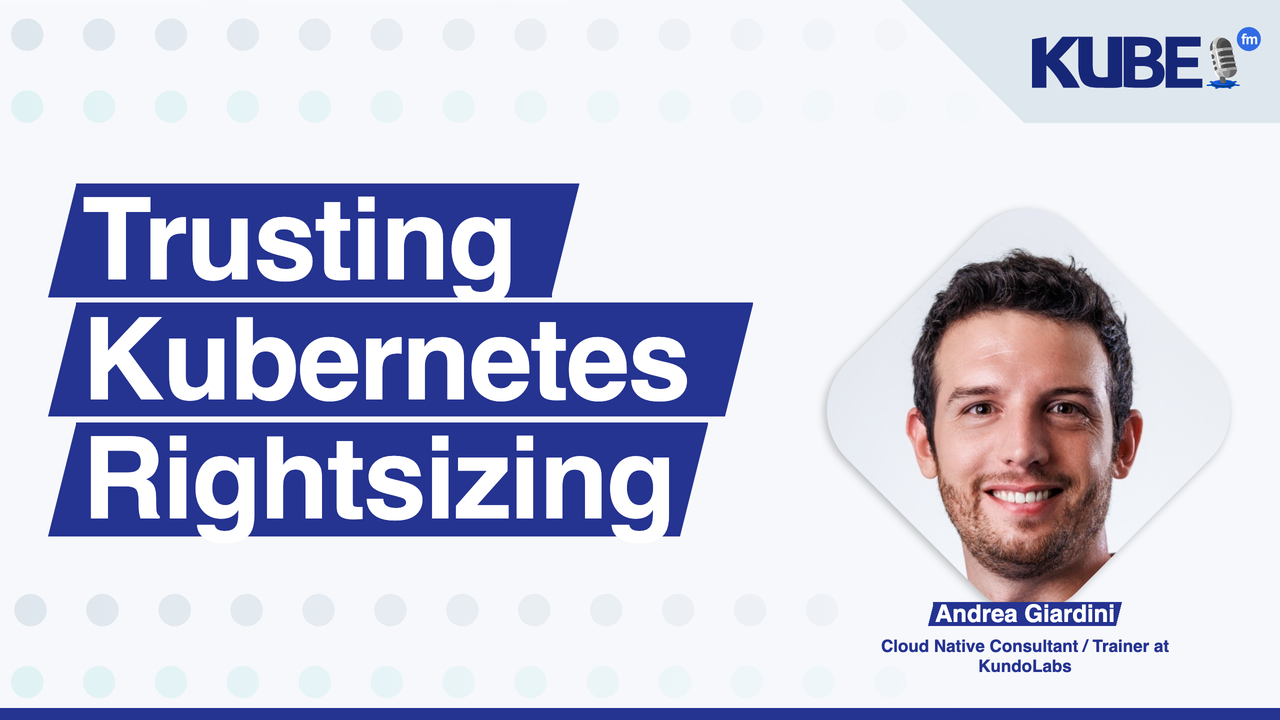
Bart Farrell: So first things first, who are you? What's your role and where do you work?
Andrea Giardini: Hi, I'm Andrea. I work for a company called KundoLabs. I'm the founder and the lead consultant there. We do a lot of infrastructure for AI and data workloads.
Bart Farrell: What are three emerging Kubernetes tools that you're keeping an eye on?
Andrea Giardini: Interesting question. One of them I'm really curious about is Kairos, this immutable open source OS. And if we move more towards the AI and data space, I really would like to get more into Knative and KServe tools. So I think they're really interesting and there is a lot of work happening there.
Bart Farrell: One of our podcast guests, Yasmin, mentioned that you can only go as fast as the speed of trust. When your team is automating resource changes across hundreds of workloads, what does it actually take for engineers to let go and trust the machine?
Andrea Giardini: It's a very good question as well. Building a platform, I think it's very important, but building trust in the platform, it's even more important. You're having the possibility of having developers that trust what you've built, that know how to do it, how to do things, how to debug it, how to monitor it, and so on. It is really important so that they can build trust over time. And really treating your platform as a product is key in this sense. Listen to your users, listen to your developers, and figure out what is missing, and build the tools that allow them to do their job in the best possible way.
Bart Farrell: In-place pod resizing just went GA, which means you can adjust CPU and memory without restarting pods. How does that change the way you think about rightsizing? Is continuous tuning finally realistic?
Andrea Giardini: It's very interesting. There has been a lot of talk about in-place pod resizing, and I'm really curious to see how people are using it. I think it's one of those things that is definitely going to help, especially in the age right now where AI and data is everywhere. I am also confident that over the past many years, we have built workloads that are redundant that are resistant to this kind of problems. You know, when a node breaks, it comes up. Self-healing has been a mechanism in Kubernetes for a very long time. So I think it's going to be useful, maybe not as useful as we think. Let's see.
Bart Farrell: Most teams start with manual resource requests and maybe a VPA recommendation they never applied. What does the path from we set requests once and forget to we trust automated rightsizing and production actually look like?
Andrea Giardini: It's about building trust. As we were saying before, building a platform that works with your developers and not against your developers is key here. Building trust over time, giving them the possibility to adapt to change, and listening to your developers, to their feedback constantly, is what helps the most building this kind of trust. Going from like a manual approach to a more automated approach requires a lot of trust in the system. It's not something that comes from one day to another. And I feel like with this automated system, as we try to integrate it more and more into our clusters with this AI recommendation system. I think things are going to come, but it might take a little bit of time. You know, AI hallucinations are still there and they are there in LLMs as they are in this kind of recommendation system. It's a slow process, but I think we will get there eventually.
Bart Farrell: Kubernetes turned 10 years old almost two years ago. What should we expect in the next 10 years?
Andrea Giardini: Well, this is the exciting part about Kubernetes. When we were moving from VMs to containers, Kubernetes was able to adapt. Now that we are working towards AI, Kubernetes is able to adapt. I always say to everyone that the nicest thing about Kubernetes is their extensible API, the possibility to extend the control plane as you want. And what is going to happen from now on? AI is very much still here. I know it's a big buzzword, but I still think we are in the early stages of understanding how AI can help us do our job better. Many people talk about cloud, many people talk about vibe coding and so on. I feel like there is still a lot of space and there's still a lot of discovery to be done in this space. I think it's going to be a couple of very interesting years over the past, over the next two or three years to see which tool will lead the path and which assumptions will not work out.
Bart Farrell: What's next for you?
Andrea Giardini: What's next for me? Well, KubeCon for the next couple of days. It's always an interesting event. Lots of sponsors, lots of clients and people to talk with. A lot of interesting use cases, as I was saying before. It's going to be an interesting couple of days and after that I will continue working on my own company. kundolabs.com is going to be great and we're going to have more and more interesting use cases to show off at conferences like this one.
Bart Farrell: And how can people get in touch with you?
Andrea Giardini: Best way is kundolabs.com. You can find everything about my profile, everything I do. And you can also search my name on YouTube and you can find plenty of talks about the interesting projects we have in the domain of data and AI.