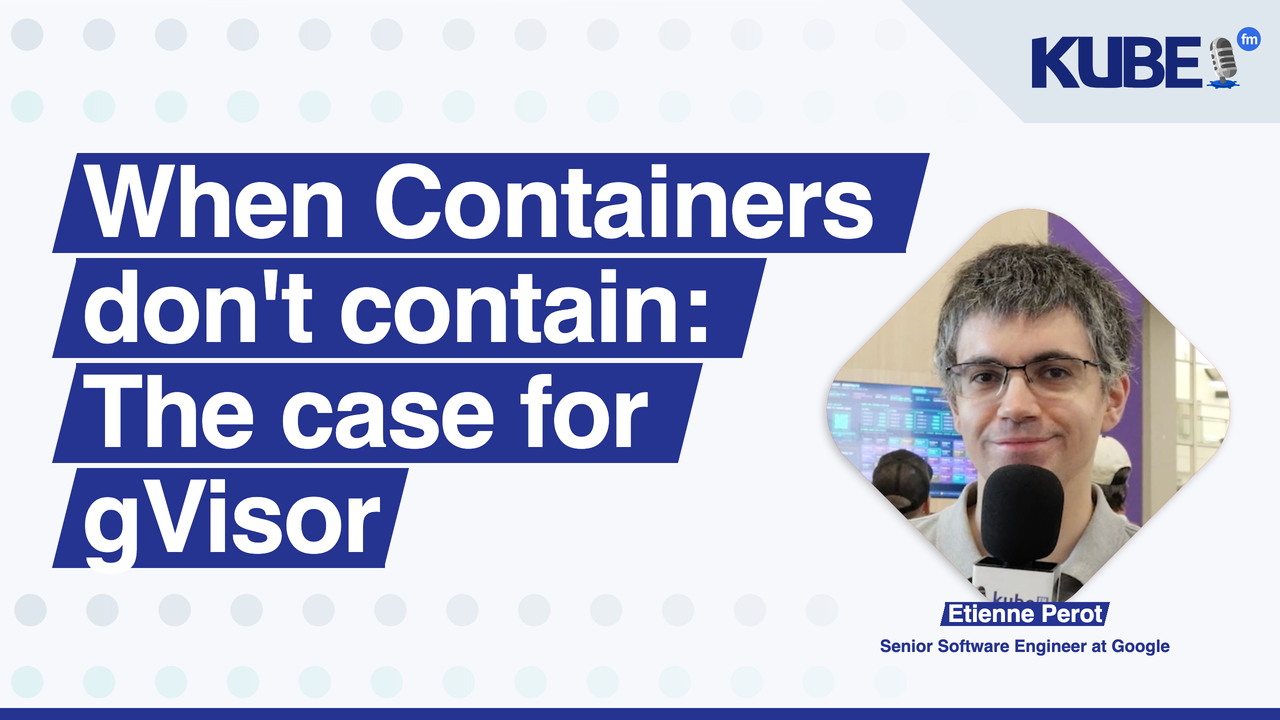
Bart Farrell: First things first, who are you, what's your role, and where do you work?
Etienne Perot: Hi, my name is Etienne Perot. We're here at the Google Cloud booth. I work on gVisor in the Bay Area, and we're excited to talk.
Bart Farrell: AI agents are increasingly downloading dependencies and executing code autonomously. Are we making a dangerous assumption that traditional container isolation is good enough for workloads we don't fully control?
Etienne Perot: If you had asked me this question a few months ago, I would have said yes, that there is a strong lack of understanding of the need for sandboxing across the industry. But I think one of the pivotal moments that happened a few months ago was the OpenAI Hugging Face incident. And as soon as details from that incident came out, I think it became clear to basically everyone, even outside of the security industry, that sandboxing is no longer optional and that we need it for even general-purpose workloads. In the security industry and in the sandboxing space, we have this saying that containers don't contain. And I think we are basically seeing that awareness propagate across the industry. And it's been great to see the industry waking up.
Bart Farrell: So gVisor provides an additional isolation boundary, but stronger security comes with trade-offs. What protection does it actually add? And where does the performance or compatibility overhead become difficult to justify?
Etienne Perot: Complex question. You're talking about three different aspects, on security, on compatibility, and on performance. And there are always trade-offs between the three. Security doesn't come for free; you have to pay for it somehow. And usually out of those three, security is the one that is the least flexible, because it is dictated by the nature of your product. So if you're dealing with untrusted inputs, if you're dealing with LLM-generated code that you haven't vetted, or if you're dealing with untrusted workloads in general, you need some type of sandboxing. In terms of level of isolation, so what gVisor gives you is isolation of the shared host kernel. In traditional containers, you're only one Linux kernel exploit away from a container escape, whereas with gVisor, you have to first break out of the gVisor sandbox before you can even get to the Linux kernel that the sandbox is running on. It's similar in that sense to virtual machines, where you have to first break out of the virtual machine before you can get to the Linux kernel and escape out of that sandbox. I think one or two weeks ago, OpenAI published this blog post called A Thousand Fewer Paths to Root, in which they describe almost 1,000 Linux privilege escalation exploits. And this is exactly the type of vulnerability that gVisor helps protect against because it removes the ability for the sandbox workload to be able to directly interface with the Linux kernel. So once you've determined the level of security that you need, then that affects the other two, meaning performance and compatibility, because it limits the set of options that you have to choose from. Because if you have determined that you need this type of isolation, you can now no longer consider traditional containers as part of the baseline to compare against. And so when you're then considering compatibility or performance, you can't compare to those. What you have to compare to is those that give you a similar level of security. And so those would be virtual machines, because they're the ones that provide also the same level of kernel-level isolation. And so within that as a baseline, that's when you have to consider compatibility and performance. So on compatibility, gVisor is a user-space reimplementation of Linux. What that means is that whenever your application tries to interface with the kernel the way it would in a traditional container, in gVisor, it is interfacing with the gVisor kernel itself, which is an implementation of a kernel that's written in Go. And it's a lot more safe in general because it's written in Go, in a memory-safe language. It implements a smaller portion of the Linux kernel. And so for this reason, also, it does have some compatibility gaps because we haven't implemented them yet. So there are some exotic Linux subsystems like perf_events that, for example, will not work in gVisor. We're always improving compatibility, but there are some that will not work. Still, in terms of compatibility, we've made massive leaps and bounds in the last few weeks and months. You can run Docker, you can run Kubernetes, some Kubernetes components. You can run agents, you can run OpenClaw, you can run Hermes; they work just fine. You can run systemd as well. You can run desktop and computer use applications; you can run browsers; all of those work just fine in gVisor. If you have determined that an application didn't work in gVisor a few months ago, I would encourage you to try it again. That said, microVMs, because they use full Linux, will be in general more compatible. So if you really do have a workload that doesn't work in gVisor, then move to microVMs. Now, lastly, on performance. So in gVisor performance, there's an overhead due to the fact that for I/O and for networking, we need to copy bytes in and out of the sandbox, and this copy adds overhead. So you see it most in workloads that are bottlenecked on those. So the worst case would be a database workload because that's bottlenecked on exactly those two things. But on anything else, like a GPU LLM server type of workload or any compute workload, general Python applications, those types of things, you don't see as much of an overhead. And again, for baseline purposes, you have to consider what you're comparing against. So if you're comparing against something like microVM-based runtimes, those also have their own overheads. If you're running inside a virtual machine and you need microVMs, you need nested virtualization. And the overhead of nested virtualization is usually much higher than the one of gVisor. So already that gives you better performance with gVisor. The other thing I would mention is that when you're looking at agentic workloads, the aspects of performance that matter aren't so much the ones we've discussed so far, which are performance at runtime, but it's the things around the sandbox. It's things like sandbox startup speed. It's things like checkpoint efficiency. It's things like memory density. And I think for all of these, you'll find that gVisor is always extremely competitive on all of these metrics because we try to be extremely fast and dense to start and to checkpoint. And so I would also look at those metrics when you're evaluating your options.
Bart Farrell: With gVisor moving into the CNCF, what can engineers deploy today to evaluate it with untrusted AI-generated code? And what should they test to determine whether the security benefits outweigh the operational costs?
Etienne Perot: So gVisor is an open-source OCI-compatible container runtime, which means that it can be installed wherever containers run. You can use it in Docker, you can use it in Podman, you can run it with Kubernetes, obviously. And with Agent Substrate having also been recently released and donated to the CNCF at the same time as gVisor, you can use gVisor's integration inside the Agent Substrate. And I think in terms of what people should test, that's one of the easiest ways to get started and it also lets you very easily interchange between that and Agent Substrate's microVM integration. So you can try both and see what you prefer. In terms of whether or not the operational overhead is worth it, I would also consider your other options. If you're comparing it against microVMs, they usually have three moving parts operationally. They have a guest image, they have a guest kernel that's Linux, which needs to be patched for all the CVEs that it has, and there's the hypervisor. And so these three have to be kept up to date, whereas gVisor is just one component, which is gVisor itself, and it acts a lot more like a native container in that respect. It's the same type of binary as runc or containerd; it's just one component that you upgrade the same way you upgrade any other. You should look also at our security track record on gvisor.dev, which should give you a sense of how often there are sandbox escapes within gVisor. I think you'll find that it's not that often. And that also should inform considerations for operational overhead and efficiency.
Bart Farrell: What's next for you?
Etienne Perot: I'm going to make sure that gVisor keeps being on the bleeding edge of competition. We're going to make our Substrate integration as smooth as possible. We just announced the donation of gVisor to CNCF. So we have a lot of operational work to do to make that happen, to move the repos in the correct place and make sure that companies outside of Google have maintainer access and the ability to submit code very smoothly for gVisor.
Bart Farrell: And if people want to get in touch with you, what's the best way to do that?
Etienne Perot: I'm Etienne Perot. You can go on gvisor.dev and see some contact information there. We have a discussions page on GitHub that you can use for contact. We have a mailing list and have a personal website if you'd like.